AI Agency vs In-House Team: The Real Cost Comparison
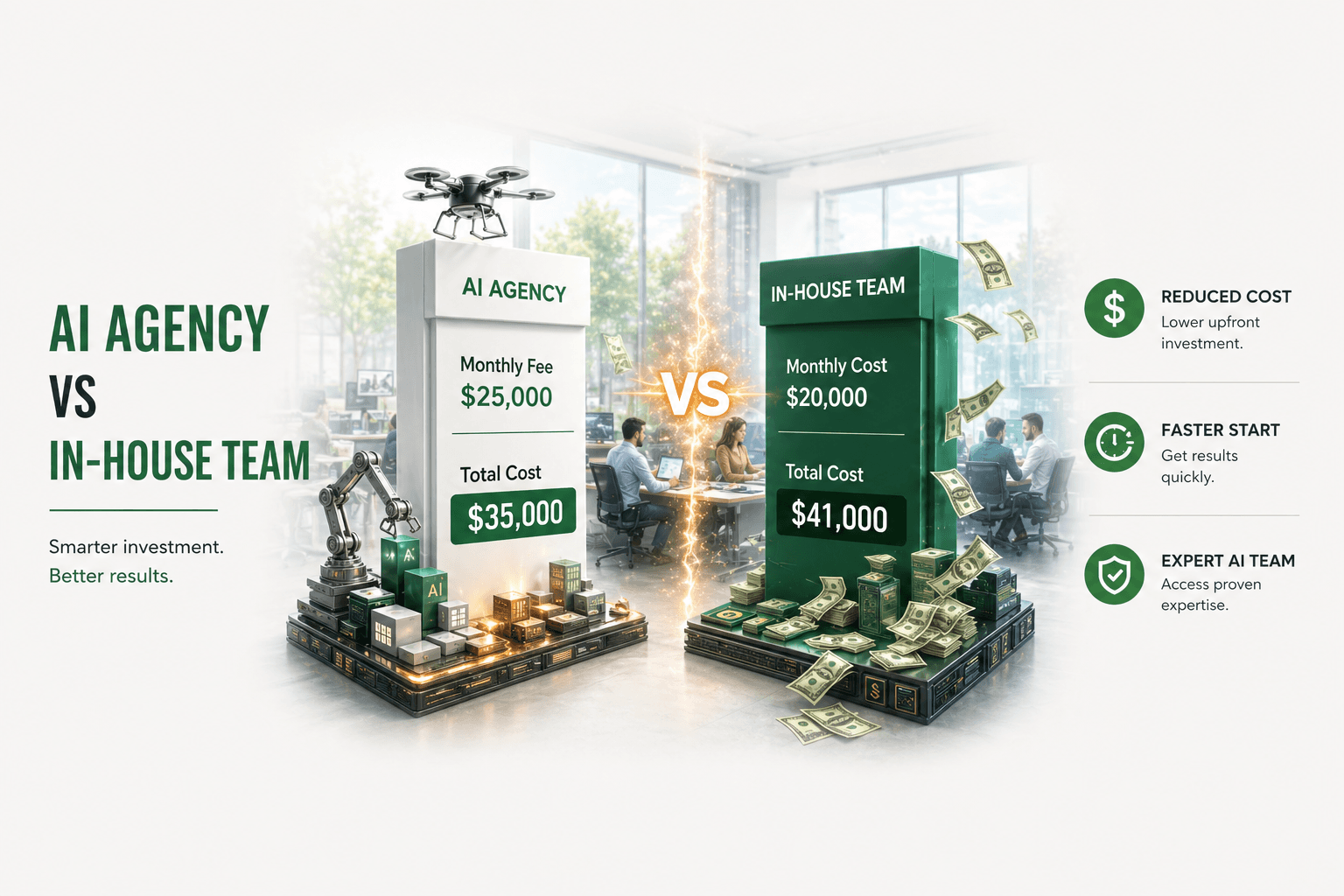
An AI agency wins on speed and breadth.
In-house wins on domain depth.
Most companies need both. The question is not which model is categorically better it is which model is right for this project, at this stage, given your timeline and risk appetite.
When a CTO asks "should we hire AI engineers or work with an agency?", the honest answer depends on four factors: how fast you need to move, how proprietary your data and logic really are, whether you can hire the right people in time, and whether you want to own this capability forever or ship a result now.
AI Agency
SPEED
Ships in weeks. No hiring, onboarding or alignment overhead.
In-House Team
DEPTH
Accumulates domain knowledge. Owns proprietary models long-term.
The True Cost Comparison
The mistake most teams make is comparing a recruiter's salary figure to an agency day rate. The real comparison is total cost of ownership over twelve months, including the hidden costs that rarely appear on a hiring plan.
| Cost Item | In-House (per engineer/yr) | Agency (project-based) |
|---|---|---|
| Base salary | £120,000–£200,000 | Included in project fee |
| Employer NI + pension | ~£18,000–£30,000 | |
| Recruiting & headhunter | £15,000–£40,000 one-time | |
| Onboarding time (lost productivity) | 2–3 months | |
| Tooling & GPU compute | £5,000–£20,000/yr | Included or pass-through |
| Management overhead | ~20% of manager time | |
| Redundancy risk if project ends | High | None |
| Total Year 1 estimate | £160,000–£290,000+ | £20,000–£80,000 delivered |
The first in-house hire rarely ships production AI in year one. Between recruiting, onboarding, and alignment, you often spend £200k+ before a single model is in production.
Speed to Value
Time is the dimension most companies underestimate. Building an in-house AI team is not just expensive it is slow. And in most business contexts, a working AI system in six weeks beats a perfect one in nine months.
Average time from job posting to first production commit for a senior AI/ML engineer in the UK, including interviews, notice periods, and onboarding.
Typical Tectome project timeline from kickoff to first working deployment, depending on complexity. MVP AI agents often ship in under four weeks.
Productivity lost in the first quarter of a new in-house hire due to context-building, stakeholder alignment, and codebase familiarisation.
"We needed an AI document processing pipeline before our Series A. Hiring wasn't an option we had eight weeks. Tectome had it live in five."
When In-House Actually Wins
In-house is not always the wrong answer. There are specific conditions where owning the team is clearly the right call and getting this wrong in either direction is expensive.
Core Intellectual Property
If your AI model IS your product your moat is the training data, the fine-tuning, the proprietary architecture then you need in-house engineers who accumulate institutional knowledge over years.
Proprietary Model Training
If you're fine-tuning on highly sensitive, proprietary datasets that cannot leave your environment, internal engineers with controlled access are the only viable path.
Regulated Data Residency
Financial services and healthcare companies with strict data residency requirements (FCA, NHS, GDPR enforcement) may not be able to share data with external parties at all.
Long-Term Capability Building
If AI is a 10-year strategic programme rather than a project, building internal capability makes sense. The compound knowledge value eventually outweighs the hiring cost.
When an Agency Wins
An agency wins in the majority of project contexts especially at the early stages of AI adoption. The pattern is consistent: companies that try to hire their way into a first AI deployment almost always ship later, spend more, and take on unnecessary hiring risk.
- You need an MVP or POC within 4–12 weeks to validate a hypothesis or close a deal.
- You need niche expertise LLM fine-tuning, RAG pipelines, agentic workflows that you cannot hire fast enough.
- You have a hard deadline: a product launch, an investor demo, a go-live commitment.
- Your internal team needs AI capabilities added to an existing system without pulling engineers off the core roadmap.
- You want to test an AI use case before committing to full-time headcount.
- You need a team that has already solved similar problems and can move without a learning curve.
CloudFO
A finance team needed an AI agent to automate document extraction and compliance checks. Hiring was off the table the window was 6 weeks. Tectome delivered a production-ready system processing thousands of documents monthly.
TrainED
An edtech startup needed AI-powered personalisation built into their LMS before a major partnership launch. Tectome augmented their existing engineering team bringing AI expertise without a new hire and shipped on time.
Decision Framework
Score your situation across these five dimensions. For each question, award 1 point if the answer points toward agency, 0 if it points toward in-house. A score of 3 or above means an agency engagement is likely the right starting point.
| Question | Agency (score 1) | In-House (score 0) |
|---|---|---|
| 1. Timeline | Need delivery in under 3 months | Can wait 6+ months to hire |
| 2. Budget | Project budget under £150k | Can invest £200k+ year one |
| 3. Data sensitivity | Standard APIs, non-regulated data | Highly sensitive, can't share externally |
| 4. Ongoing need | One-time project or time-limited | Permanent, evolving capability |
| 5. Skill gap | No AI engineers internally | Strong existing engineering team |
Score 4–5: Strong agency case. Score 2–3: Consider a hybrid agency for delivery, in-house for ongoing ownership. Score 0–1: In-house is the right long-term investment.
How Tectome Works as Your AI Partner
We work as an extension of your team you keep ownership of the code, we bring the expertise. Every project is handed over with full documentation, clean architecture, and no lock-in. Your internal team can take over, extend, or maintain anything we build.
You own the code
All IP and source code transfers to you at project end. No proprietary wrappers, no vendor lock-in, no ongoing dependency on us to keep the lights on.
We embed, not consult
We join your Slack, attend your standups, and work inside your process. No hand-waving we build the actual system.
Fixed-price scoped delivery
You know what you're getting and what it costs before we start. No scope creep, no hourly billing surprises.
Knowledge transfer included
Every project ends with a handover session and documentation so your team fully understands what was built and why.
Talk Through Your Options
Not sure whether to hire or partner? Book a free 30-minute call and we'll give you an honest answer even if the answer is that you should hire.
Key Takeaways
An AI agency wins on speed and breadth; in-house wins on domain depth. Most companies at early AI adoption stages benefit from starting with an agency.
True in-house cost in year one typically exceeds £160,000 per engineer once salary, NI, recruiting, onboarding, and tooling are included.
An agency can deliver working AI in 2–8 weeks. The hiring pipeline alone takes 3–6 months.
In-house is justified when AI is core IP, data cannot leave the organisation, or you're building a permanent capability over a multi-year horizon.
The best model for most companies is hybrid: agency for early delivery and expertise, in-house for long-term ownership once the product is validated.
Related services
Ready to Move Faster on AI?
Whether you need to ship an MVP, augment your team, or just work out the right structure let's talk.

From our work
Read how we did this for…

Accelerate your roadmap with AI-driven engineering.
Click below to get expert guidance on your product or automation needs.