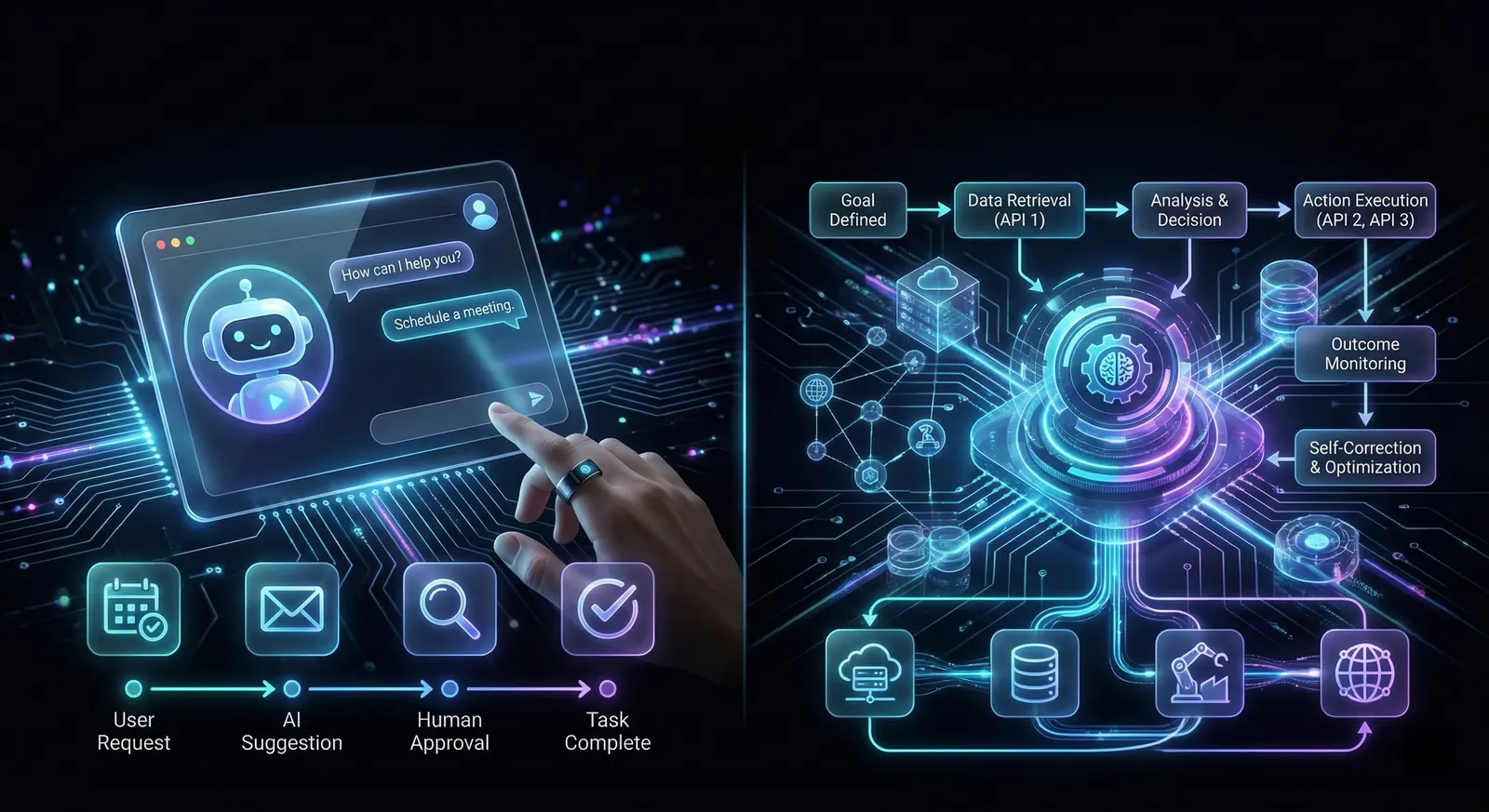
Many people use these terms interchangeably but they represent two very different ways of working with technology. Choosing the right approach is the difference between having a helpful chatbot and building a system that actually gets work done for you.
AI Agents vs AI Assistants: The Key Difference
The Main Point
Think of an assistant as a partner you talk to and an agent as a team member you give a goal. While assistants are great for brainstorming and drafts, agents are built to navigate software and complete tasks without constant supervision.
The Simple Comparison:
Brain Power vs Extra Hands
Understanding the fundamental distinction in AI behavior.
Assistants: Your Thinking Partner
These systems are reactive. They wait for you to ask a question or give a prompt. While they are incredibly smart at drafting emails or summarizing long reports, they don't actually go into your other software to finish the job for you.
- Tools like ChatGPT or Claude for ideas
- Summarizing long documents or research
- Writing drafts for emails and social posts
- Tasks that need you to click send
Agents: Your Digital Workforce
These systems are goal oriented and proactive. Instead of waiting for every single step, you give them a final objective. The agent then plans the necessary steps, connects to your systems, and completes the work on its own.
- Running tasks from start to finish
- Connecting different apps automatically
- Monitoring systems and fixing errors
- Triggering actions based on events
Moving from Talking to Doing
In this video, we look at how AI is evolving past simple chat boxes. We show real examples of agents navigating enterprise software and making decisions that actually impact the bottom line.
Why many AI projects don't work out
It might be surprising, but most AI projects fail for very human reasons. It is rarely the fault of the technology itself and usually comes down to how the work was designed from the start.
Picking the wrong tool
Sometimes an assistant is used for a job that needs an agent, or a complex agent is built for a task that only needs a simple draft.
Vague ideas of success
Many teams start using AI without deciding what success looks like, whether that is saving time or increasing revenue.
Forgetting about humans
Technology works best when it is monitored by people who can step in if the system makes a mistake or hits a roadblock.
What does an AI Agent actually do?
At a basic level, an AI agent is a system you can trust with a goal. Instead of you manually moving data from one place to another, the agent takes over the process and sees it through to the end.
Finding and Qualifying Leads
The agent looks at new leads, gather extra details about them, and decides who needs a follow up right away.
Handling Support Requests
It can solve common customer problems on its own and only passes the tricky ones to your human team.
Managing Finance Tasks
It tracks incoming invoices, checks them for errors, and makes sure everything is ready for payment.
Straightening Out Operations
The agent keeps an eye on your inventory levels and automatically places orders when things get low.
The process behind the scenes
- Setting the Goal: You tell the agent to qualify new inbound leads.
- Listening for Triggers: The agent waits for a new form submission or an email.
- Thinking it Through: It uses logic and models to decide the best next step.
- Taking Action: It updates your CRM and sends a notification to the right person.
- Learning and Improving: The system checks if the goal was met and gets better over time.
How to measure success with AI
If you don't keep track of how your AI is performing, it is hard to tell if it is actually helping your business. The best teams look at a few simple metrics to make sure their investment is paying off.
Metrics for Assistants
- Time saved for each person every week
- How often the team uses the tool
- Faster completion of internal tasks
- The overall quality of the drafts produced
Metrics for Agents
- Percentage of tasks finished independently
- Reduction in the cost of each task
- How much faster a process becomes
- The rate of errors or needed interventions
Choosing your starting point
The choice between an assistant and an agent is about where you want to spend your time.
Path 1: The Assistant
Choose this if you need help with creative work, drafting, or brainstorming. An assistant keeps you in the driver's seat while handling the heavy lifting of research and synthesis. It's about augmenting your individual productivity.
Path 2: The Agent
Choose this if you perform repetitive steps across different software every day. Agents excel where there are clear rules and measurable results. They take the entire process off your plate so you can focus on strategy.
The secret is how humans and AI work together
The most successful companies are not trying to replace their people with technology. Instead, they are rethinking how work gets done so that their team can focus on what they do best while the AI takes care of the rest.
Humans are still the experts when it comes to making complex decisions and navigating uncertainty. AI agents are the experts at staying consistent and handling work at a massive scale.
Human Approval Needed
The AI suggests a path but wait for a person to give the green light. This is standard for sensitive areas like legal or finance.
Monitoring from Above
The AI works on its own most of the time while a person keeps an eye on the dashboard and jumps in only if something looks wrong.
Mostly Independent
The AI handles routine work without any intervention. You still perform regular audits to make sure everything is running smoothly.
Keeping your systems safe and compliant
Since AI agents are often given the power to take real actions across different software, security must be built into the system from the very first day. It is not just about protecting data; it is about ensuring every action is authorized and reversible.
Limited access
Agents should only have access to the data they need to do their specific job, following the principle of least privilege.
Protected credentials
Each agent should have its own separate keys and permissions, ensuring one leak doesn't compromise the whole system.
Action limits
Clear boundaries prevent the AI from getting stuck in an infinite loop or performing too many high-stakes actions at once.
Manual kill switch
There should always be a way for a person to stop the agent instantly if any unexpected behavior is detected.
Clear tracing
Every single step the agent takes must be recorded in an immutable audit log so you can verify its logic later.
Compliance Ready
In regulated industries, we ensure agents meet SOC 2, ISO 27001, HIPAA, and GDPR requirements.
Planning for when things go wrong
The tricky thing about AI agents is that they don't always make a loud noise when they fail. Sometimes the errors are quiet and build up over time. Success depends on catching these signals early.
01Slow behavior changes
The agent might start acting differently as the data it works with changes over time.
Set up weekly checks and automated alerts to catch anything that looks unusual compared to the baseline.
02Feedback loops
Multiple agents can accidentally trigger each other and create a cycle that never ends.
Use strict limits on how many actions can be taken in a short window of time.
03Outdated rules
Original business rules can become old and no longer apply to your current situation.
Meet with experts every quarter to review and update the logic the agent is using.
04Blind trust
People might stop questioning the AI and assume it is always right when it is not.
Make it a habit to sample and check the work the agent is doing regularly through manual audits.
How agents change the way teams work
As AI agents start to take over more of the day to day operations, the structure of your team begins to shift from manual execution to strategic oversight.
Leaner Teams
Get much more done without increasing headcount.
Strategic Oversight
Shift from doing manual work to overseeing the process.
New Tooling Roles
Focus on managing and improving these automated systems.
Results Oriented
Fewer people needed for coordination, more focus on final output.
"The most successful teams treat their agents like new team members. They need to be trained, monitored, and given regular feedback so they can improve over time."
AI Agent vs AI Assistant: Full Feature Comparison
A clear breakdown of how these two types of AI differ across every dimension that matters.
| Different Features | AI Assistants | AI Agents |
|---|---|---|
| Main focus | Helping people think and write | Completing tasks and goals |
| How it acts | Wait for your prompt | Acts on its own |
| System access | Mostly conversational | Uses your other software |
| Main benefit | Saves time on tasks | Automates entire processes |
| Human role | Does most of the work | Oversees the outcome |
| Core Value | Speed to draft | Speed to result |
START YOURAUTOMATION JOURNEY.
The future of work is not about talking to robots. It is about building a digital workforce that can get the job done for you.
Frequently Asked Questions
What is the primary difference between AI agents and AI assistants?
The primary difference is autonomy. AI assistants are reactive they wait for your prompt and respond with text or a draft. AI agents are proactive you give them a goal and they plan the steps, connect to your software, and complete the work without needing input at every stage.
Which is better for business: an AI agent or an AI assistant?
It depends on the task. AI assistants are better for creative input, drafting, or analysis writing emails or summarising reports. AI agents are better for repetitive, multi-step processes lead qualification, invoice processing, or order management. Most businesses benefit from both.
Can AI agents replace AI assistants?
Not entirely. AI agents handle execution and automation, but AI assistants are still better for tasks that require nuanced thinking or human-in-the-loop decisions. The two are complementary rather than competing.
What are real examples of AI agents vs AI assistants?
AI assistants: ChatGPT, Claude, Microsoft Copilot drafting, answering questions, summarising. AI agents: systems that automatically qualify leads and update your CRM, process invoices end-to-end, monitor inventory and reorder stock, or route and resolve support tickets without human input.
Related services