AI Automation Consultant vs Agency: Two Very Different Engagements
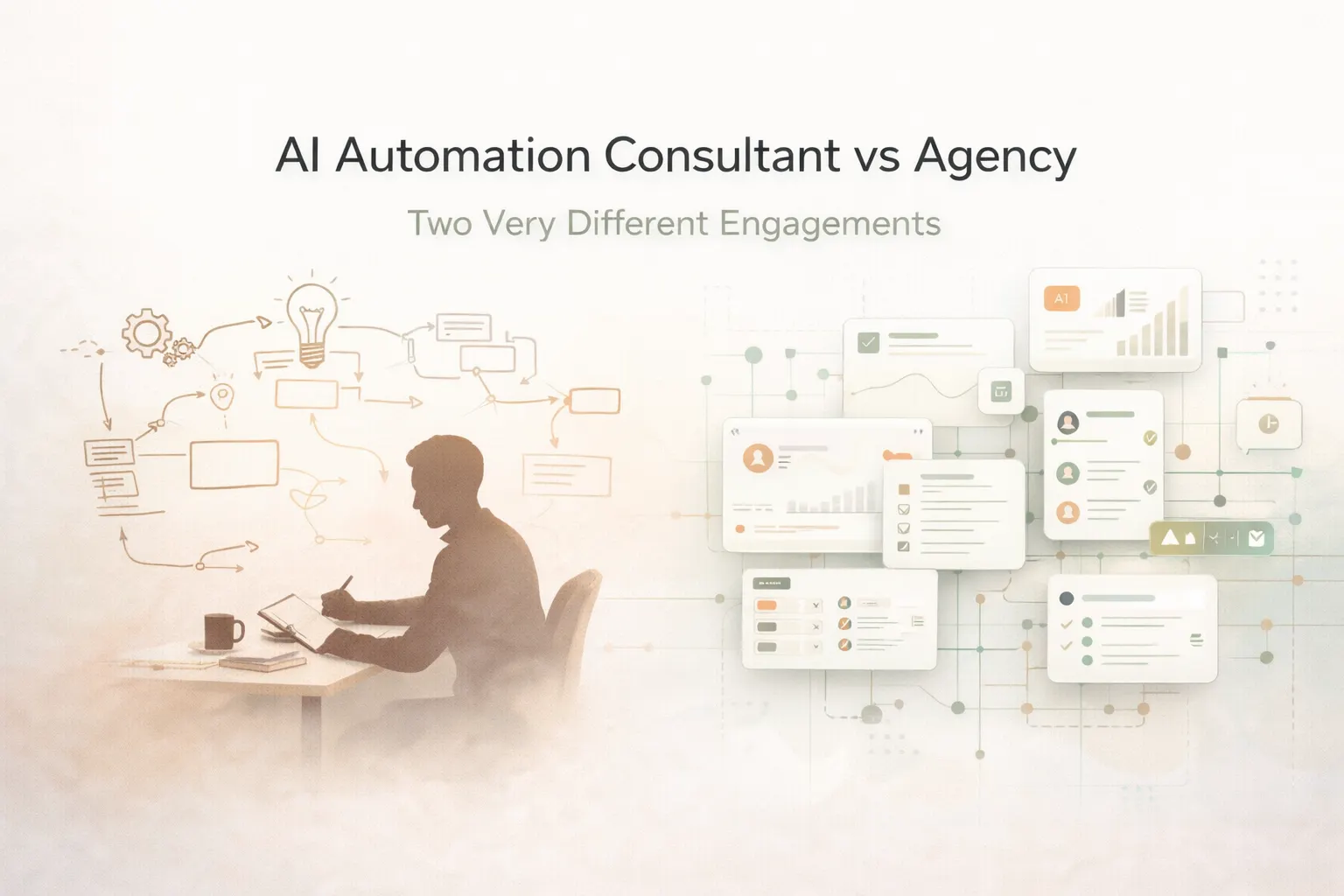
A consultant tells you what to build.
An agency builds it.
That one sentence is the whole answer. But when you're evaluating how to move forward with AI automation, the distinction matters enormously because hiring the wrong type of firm for your stage will cost you time, money, and momentum.
An AI automation consultant is an advisor. They analyse your processes, identify automation opportunities, map the technology landscape, and hand you a structured recommendation. An AI automation agency is an execution partner. They take a defined brief and deliver working software agents, pipelines, integrations, dashboards that runs in production.
Neither is universally better. The right choice depends entirely on where you are in the journey: do you need clarity on what to build, or do you already know and need someone to build it?
Consultant
STRATEGY
Clarity, direction, and a roadmap. No code written.
Agency
EXECUTION
Working systems shipped to production.
What a Consultant Delivers
An AI automation consultant is engaged for thinking, not building. A typical engagement runs 4–12 weeks and culminates in a structured set of deliverables reports, roadmaps, vendor shortlists, ROI models rather than production software.
Process Discovery & Mapping
The consultant audits your current workflows, identifies which processes are automation candidates, and documents the inputs, outputs, decision points, and exception paths for each.
Vendor Selection & Architecture Advice
They evaluate the AI tooling landscape LLM providers, orchestration frameworks, no-code automation platforms and recommend the right stack for your context, without being tied to selling any particular product.
ROI Modelling
A good consultant will build a quantified business case: projected time savings, FTE equivalents, cost per transaction before and after automation, and a payback period.
Change Management Planning
Automation that isn't adopted is worthless. Consultants help you plan the organisational change who needs retraining, which roles shift, how to handle resistance.
The deliverable is a document or presentation not a system. The consultant's value ends when clarity is achieved. Execution is then handed off, either internally or to an agency.
This handoff gap is one of the most expensive friction points in AI adoption. The consultant recommends a direction; the organisation then spends additional weeks briefing an agency or recruiting engineers losing the context and momentum built during the discovery work.
What an Agency Delivers
An AI automation agency takes a defined brief and ships working software. The engagement is typically 6 weeks to 12+ months depending on scope, and the deliverable is a system in production not a recommendation about one.
Code & Integrations
The agency writes the code, wires up API integrations, builds the data pipelines, and handles the infrastructure.
Testing & QA
Edge cases, error handling, rate limits, model fallback logic all tested before go-live.
Deployment & Monitoring
The system is deployed to your environment with logging, alerting, and observability baked in.
Ongoing Support
Post-launch retainers cover model updates, bug fixes, performance tuning, and new feature development.
The agency's value is speed and expertise applied to a known problem. If you walk in without a clear brief uncertain about scope, unsure which process to automate first, or lacking stakeholder alignment you will likely pay for scope changes and rework that could have been avoided with upfront strategy work.
The best agencies work from requirements. The worst ones let vague briefs run up the clock.
Side-by-Side Comparison
Here is how the two engagement models stack up across the dimensions that matter most when making a hiring decision.
| Dimension | Consultant | Agency |
|---|---|---|
| Output | Report, roadmap, recommendations | Working software in production |
| Deliverable | Document or presentation | Deployed system |
| Timeline | 4–12 weeks | 6 weeks–12+ months |
| Who executes | You (or another partner) | The agency team |
| Ongoing involvement | Ends at sign-off | Retainer or support contract |
| Price range | £15k–£60k typical engagement | £20k–£150k+ depending on scope |
| Best for | Early-stage clarity, board buy-in, vendor selection | Defined requirements, speed to launch |
Cost and Timeline Reality
Both models represent real investment. Neither is inherently cheaper they serve different purposes at different stages.
Consultant
- Day rate: £1,500–£3,000/day
- Full engagement: £15,000–£60,000
- Duration: 4–12 weeks
- Outcome: strategic clarity, not shipped software
Agency
- Project-based pricing
- Typical range: £20,000–£150,000+
- Duration: 6 weeks–12+ months
- Outcome: working system in production
The cost profiles are broadly comparable for a defined engagement. The key difference is what you receive at the end. If you hire a consultant but don't have the internal capacity to execute on the recommendations, you've paid for a document. If you hire an agency without sufficient clarity on scope, you'll pay for rework that a discovery engagement would have prevented.
When to Use Which
The right engagement model comes down to your current state of clarity and execution capacity.
CHire a Consultant When...
- You're at early stage and haven't yet identified which processes to automate first
- You need board or executive buy-in and require a business case with hard numbers
- You want an unbiased vendor recommendation someone with no incentive to sell you a particular tool
- There is internal political complexity around automation and you need an external voice to drive alignment
- You have the internal engineering resource to execute but lack the strategic direction
AHire an Agency When...
- You know what to build and have defined technical requirements or a clear scope
- You need execution speed internal hiring would take 3+ months to even begin
- You don't have in-house AI engineering expertise and aren't planning to build it
- The project is a one-time build with maintenance, not an ongoing product requiring a full-time team
- You've done the strategy work (internally or with a consultant) and are ready to ship
Tectome's Hybrid Approach
The biggest problem with the consultant-then-agency model is the handoff gap. Once a consultant finishes their engagement, the organisation must start a new procurement cycle, brief a new team, and re-establish context often losing weeks and the nuance of the discovery work in the process.
"We run a paid discovery sprint (1–2 weeks) then move straight into build. You get strategic clarity AND execution in one engagement no handoff gap."
The discovery sprint surfaces your highest-value automation opportunity, maps the technical requirements, and produces a fixed-price build plan. The same team that discovered the problem then ships the solution. No rebriefing. No context loss. No gap.
Discovery Sprint
1–2 weeks. We audit your workflows, identify the highest-ROI automation, and define the technical scope.
Fixed-Price Build
You receive a clear quote with milestones before work begins. Same team, no surprises.
Launch & Support
Deployment, monitoring, and an optional retainer for ongoing maintenance and iteration.
This model works particularly well for organisations that want to move fast without the overhead of a separate strategy engagement and without the risk of briefing an agency blind.
Start With a Discovery Sprint
In 1–2 weeks, we'll identify your highest-ROI automation opportunity and give you a fixed-price build plan. Strategy and execution in one engagement.
Key Takeaways
A consultant delivers strategy: process maps, vendor recommendations, ROI models, and a roadmap. No code. Typical engagement: 4–12 weeks, £15k–£60k.
An agency delivers execution: working software deployed and running in production. Typical engagement: 6 weeks–12+ months, £20k–£150k+ depending on scope.
Hire a consultant when you need clarity, board buy-in, or unbiased vendor selection. Hire an agency when you have defined requirements and need speed to launch.
The biggest risk in the consultant-then-agency model is the handoff gap context loss, rework, and delays from briefing a new team after strategy concludes.
Tectome runs a 1–2 week paid discovery sprint then moves directly into build, eliminating the handoff gap and giving you strategic clarity plus execution in a single engagement.
Ready to Move From Strategy to Shipped?
Stop choosing between advice and execution. Book a discovery call and we'll handle both.

From our work
Read how we did this for…

Accelerate your roadmap with AI-driven engineering.
Click below to get expert guidance on your product or automation needs.