AI Automation in Fintech: Where It Works and How to Stay Compliant
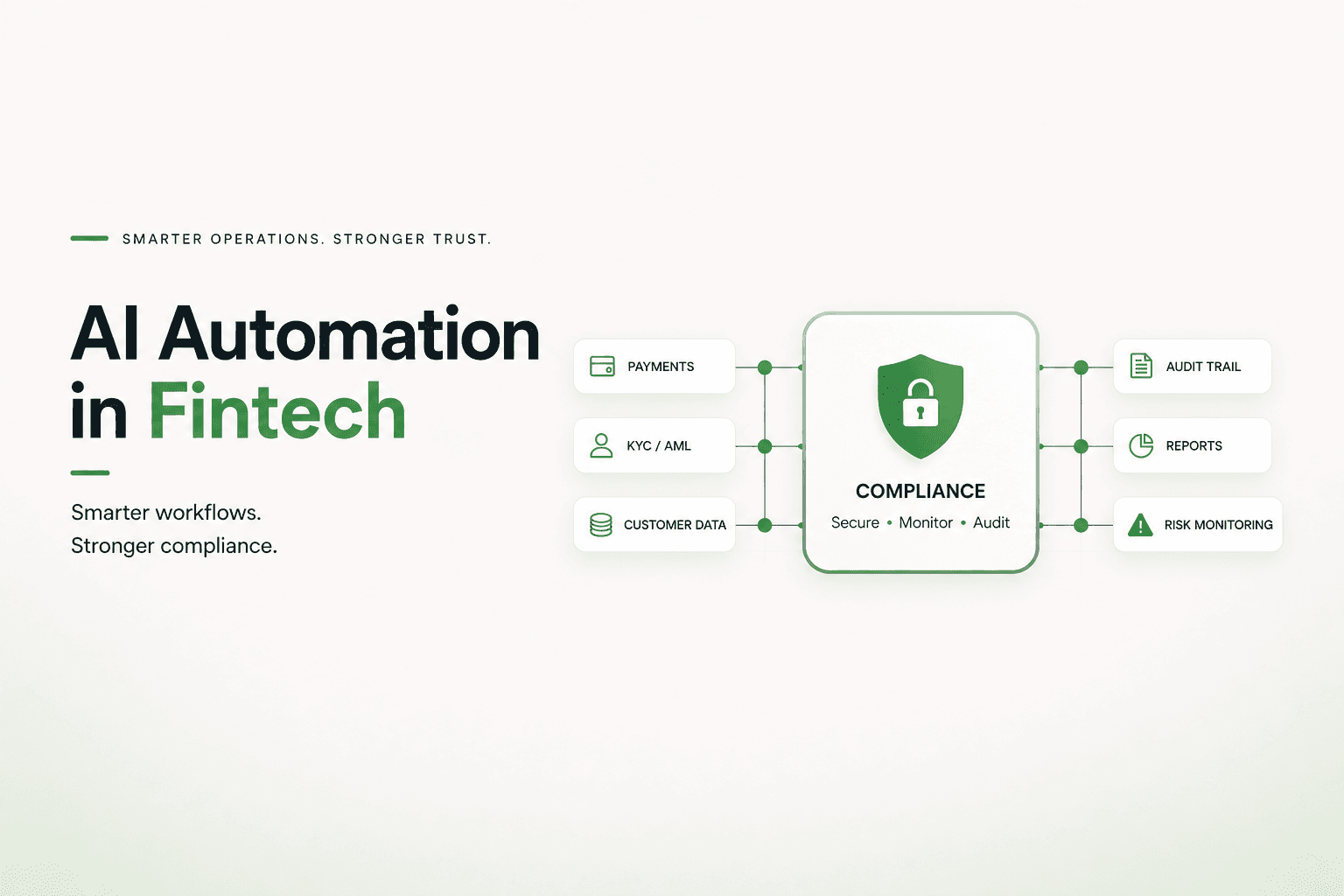
Fintech automation works best when you implement it correctly.
Fintech companies handle repetitive, high-stakes processes reconciliation, reporting, KYC checks, fraud alerts that are perfect for AI automation. The catch: compliance requirements mean you need to implement it correctly.
The opportunity is substantial. Finance teams spend over 60% of their time on manual data tasks entering, checking, reconciling, and reformatting information that a well-built automation pipeline could handle in seconds.
60%+
of finance team time is spent on manual data tasks that are prime candidates for AI automation.
The fintech companies doing this well aren't automating everything at once. They identify the highest-value workflows, build with compliance baked in from the start, and expand from there.
5 Highest-Value Workflows to Automate
Not all fintech workflows carry the same automation potential. These five consistently deliver the strongest return on implementation time and cost.
Financial Reconciliation Automation
Matches transactions across systems, flags discrepancies, and generates exception reports for human review. Eliminates the most error-prone part of the finance close cycle.
Saves 8–15 hrs/weekKYC/AML Document Processing
Extracts data from identity documents, verifies against watchlists, and routes cases to the right compliance reviewer automatically. Handles the high-volume, low-complexity checks so your team focuses on edge cases.
3 days → 4 hours per applicationRegulatory Reporting Generation
Pulls data from source systems, formats to FCA/HMRC templates, and flags anomalies before submission. Removes the manual assembly work that consumes compliance teams every reporting cycle.
Saves 2 days/month per cycleFraud Flag Routing
Classifies incoming fraud alerts by risk level and routes to the appropriate team with full context attached transaction history, customer profile, recent activity. Reduces review time by cutting through noise.
40% reduction in false positive review timeClient Onboarding Workflows
Automated document collection sequences, verification checks, and account setup steps. Customers receive real-time status updates while your team only touches exceptions.
5 days → 48 hoursCompliance & AI
Fintech automation doesn't exist in a compliance vacuum. The regulatory environment in the UK FCA oversight, GDPR, and increasingly detailed expectations around model use means that building fast and building compliantly are not optional trade-offs. You have to do both.
FCA Requirements
Automated decisions affecting consumers must be explainable. The FCA expects firms to demonstrate that AI systems don't introduce bias or unfair outcomes, and that governance frameworks exist before deployment.
GDPR
Automated processing of personal data requires a lawful basis. Customers have the right to explanation when automated decisions significantly affect them. Data minimisation applies collect only what the model needs.
Audit Trails
Every automated decision must be logged inputs, model version, output, timestamp, and the human reviewer who acted on it. An audit trail is not optional; it's how you demonstrate compliance in an examination.
Human-in-the-Loop
High-risk decisions credit, fraud adjudication, suspicious activity reports must retain a human sign-off step. Automation should prepare, classify, and recommend. The decision authority stays with a qualified person.
Model explainability is increasingly a regulatory expectation, not just good practice. If a regulator asks how your fraud model reached a decision, you need to be able to answer. Build this requirement into your architecture before you go live, not after.
Case Study: CloudFO
CloudFO AI-Powered Finance Assistant
CloudFO needed to move beyond manual financial check-ins and fragmented reporting across Xero, Stripe, and multiple banking APIs. Tectome built an AI-powered finance assistant that pulled data from all three sources, automated weekly financial check-ins, and delivered smart planning with real-time goal tracking.
3 APIs
Integration sources
Automated weekly
Check-ins
Overnight
Reporting cycle
Read the full CloudFO case study"What used to take our team days now runs overnight."
90-Day Implementation Roadmap
The fintech companies that succeed with automation don't try to automate everything at once. They move in short phases, validate before expanding, and keep compliance in every sprint.
Audit & Identify
Map all current manual workflows. Score by time cost and compliance risk. Select your top 3 automation candidates prioritising high-volume, low-ambiguity processes.
Build & Test First Automation
Build the first automation with a full audit trail and parallel running alongside the manual process. Validate outputs, get compliance team sign-off, then switch over.
Expand to Second Automation
Apply lessons from the first build. The second automation typically moves faster. Introduce human-in-the-loop checkpoints for any higher-risk decision points.
Monitoring & Optimisation
Establish performance baselines, set up drift detection for any ML components, and schedule quarterly reviews. Document the system for your compliance function.
Common Mistakes
Most fintech automation failures aren't technology failures. They're implementation failures that were predictable.
Automating before cleaning data pipelines
Garbage in, garbage out. If your source data has inconsistent formats, duplicate records, or missing fields, the automation will amplify those problems at speed.
No fallback for edge cases
Every automation will encounter a scenario it wasn't designed for. Without a clear fallback route to human, flag for review, halt and alert edge cases become incidents.
Ignoring model drift in fraud models
Fraud patterns evolve. A model that performs well at launch will degrade over time as attackers adapt. Schedule retraining and set up drift monitoring from day one.
Insufficient audit logging
Logging that 'a decision was made' is not enough. Log the inputs, the model version, the confidence score, and the human action taken. Regulators and auditors need the full picture.
Skipping user acceptance testing with the compliance team
Engineering teams test for accuracy. Compliance teams test for risk. Both perspectives are required before go-live. A system that passes technical QA but fails a compliance review is not ready.
Key Takeaways
Finance teams spend 60%+ of their time on manual data work AI automation of reconciliation, KYC, reporting, and onboarding can reclaim most of that time.
The highest-value automations in fintech are high-volume, rule-driven, and documentation-heavy exactly where AI performs best.
Compliance is not a constraint to work around. Audit trails, human-in-the-loop checkpoints, and model explainability need to be designed in from day one.
A phased 90-day approach audit, first automation, second automation, monitoring outperforms big-bang deployments and keeps compliance teams onside.
The most common failures are data quality issues, missing fallbacks, and skipping compliance UAT all preventable with the right implementation process.
Ready to Automate Your Fintech Operations?
We'll map your highest-value automation opportunities and build a compliant, auditable system your compliance team can actually sign off on.



From our work
Read how we did this for…

Accelerate your roadmap with AI-driven engineering.
Click below to get expert guidance on your product or automation needs.