AI Automation Governance: Why Most AI Systems Fail in Production (and How to Fix It)
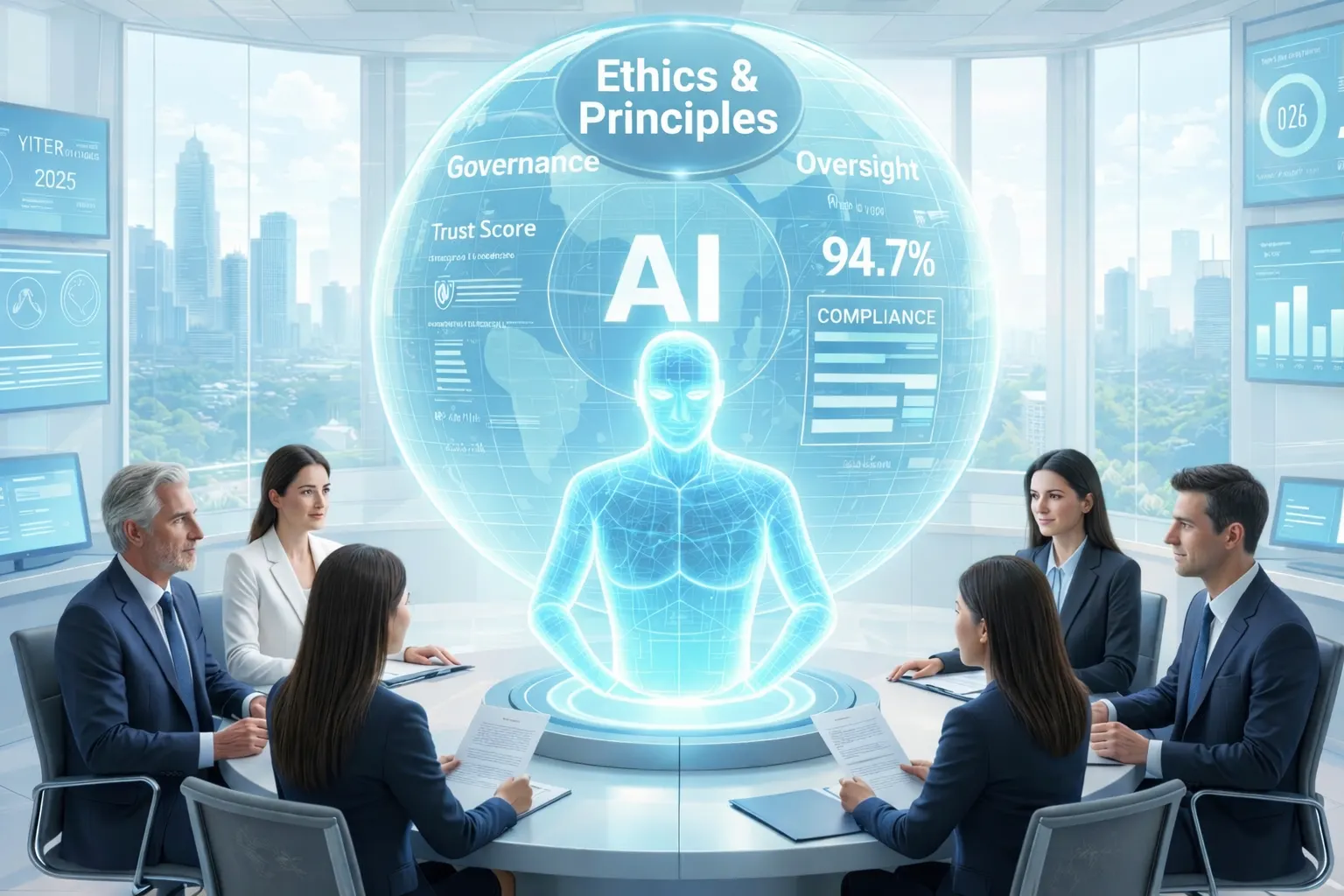
Most AI failures in production don’t come from bad models. They come from missing governance.
A model can be accurate, well-trained, and thoroughly tested, and still cause serious damage once it’s live. Governance is the difference between a high-performing asset and a quiet liability.
Quiet Failure: The Drift Trajectory
Healthy
Model performs well. High accuracy at launch.
Drifting
User behavior shifts. Subtle performance drops.
Failure
High-risk errors. Real business damage.
"AI systems fail quietly. Gradually. Then all at once. By the time someone notices, the damage has already been done."
AI is no longer a feature. It’s Infrastructure.
Automation used to follow static rules. Now it makes autonomy-driven decisions across your entire stack.
The Components
- Machine Learning Models
- Workflow Orchestration
- LLM-Powered Agents
- Global Business APIs
The Impact
"These systems don’t just analyze data. They act on it. They trigger workflows, update systems, and influence real outcomes."
This shift turns AI from simple software into core infrastructure that demands professional governance.
What AI Automation Governance Actually Means
An AI governance framework is not just documentation. It’s the system that ensures your AI behaves correctly in production. At a minimum, that includes:
Continuous model monitoring
All models degrade over time. That’s not a possibility. It’s a guarantee. Effective AI model monitoring tracks:
- Accuracy
- Data drift
- Anomalies
- Unexpected behavior
If you’re not monitoring these, your system is already drifting, you just don’t see it yet.
Explainability and transparency
Every decision should be traceable. You should be able to answer: Why did the model do this?
Without that:
- Bias goes undetected
- Errors repeat
- Trust breaks
Control and accountability
AI systems must be governed like any critical system.
That means:
- Audit logs for every decision
- Clear ownership
- Role-based access
- Human oversight for high-risk actions
No visibility = no control.
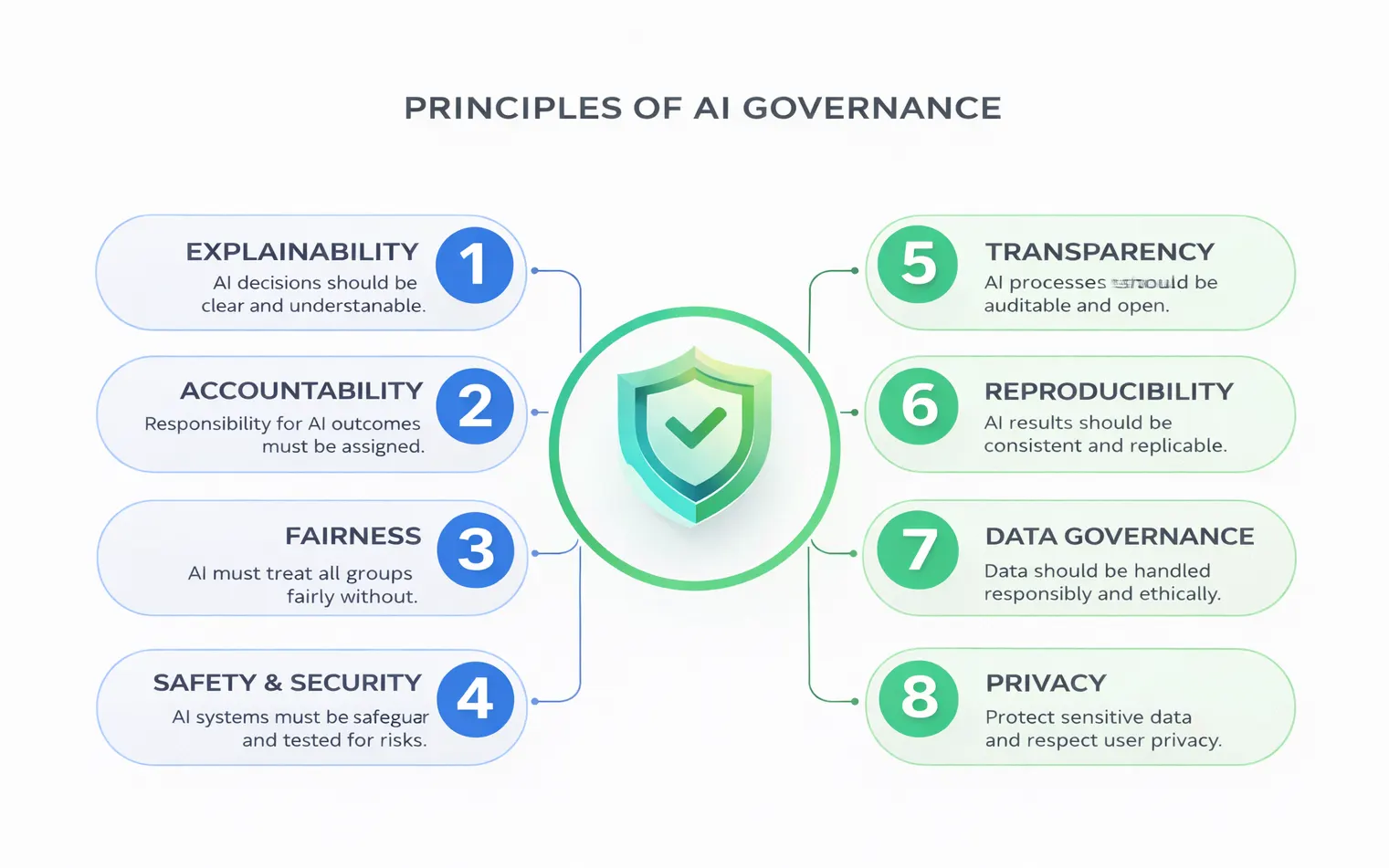
Principles of AI Governance
Where most companies get it wrong
This is the pattern we keep seeing.
Teams treat governance as something to add later. So they end up with:
- no model or dataset versioning
- monitoring limited to accuracy only
- no visibility after deployment
- no human checkpoints
- no rollback strategy
"Everything works… until it doesn’t."
And when it breaks, there’s no way to trace why.
Secure Infrastructure
With Governance
Real-time Drift Detection
Anomalies are caught instantly, triggering automated safety rollbacks.
Full Decision Traceability
Audit trails for every token and action. Total visibility on system logic.
Automated Safety Checks
Guardrails detect and block incorrect behavior before it exits the model.
The Risk Environment
Without Governance
Undetected Model Drift
Models degrade silently, causing catastrophic errors in automated decisions.
Black-box Decisions
Zeros traceability. No one knows why the AI took a specific action.
Manual Error Handling
Teams waste weeks cleaning up failures after the damage is done.
How Leading Companies Approach AI Governance

Microsoft Responsible AI
Industry Leader Case Study
- • Focuses on operationalizing responsible AI through fairness checks, reliability systems, transparency tools, and accountability structures.
- • These are not just principles, but are enforced through tooling across Azure Services.

MLOps Governance at Google
Industry Leader Case Study
- • Approaches this through MLOps governance featuring automated testing pipelines, strict version control, and continuous monitoring.
- • The idea is simple: models are continuously managed systems, not one-time deployments.

IBM Risk Management
Industry Leader Case Study
- • Designed for enterprise risk environments with strong focus on bias detection, drift monitoring, explainability, and centralized audit logging.
- • This is governance built for scale and compliance.
The Tooling That Makes Governance Real
Governance isn't manual. It's enforced through systems that detect issues in milliseconds.
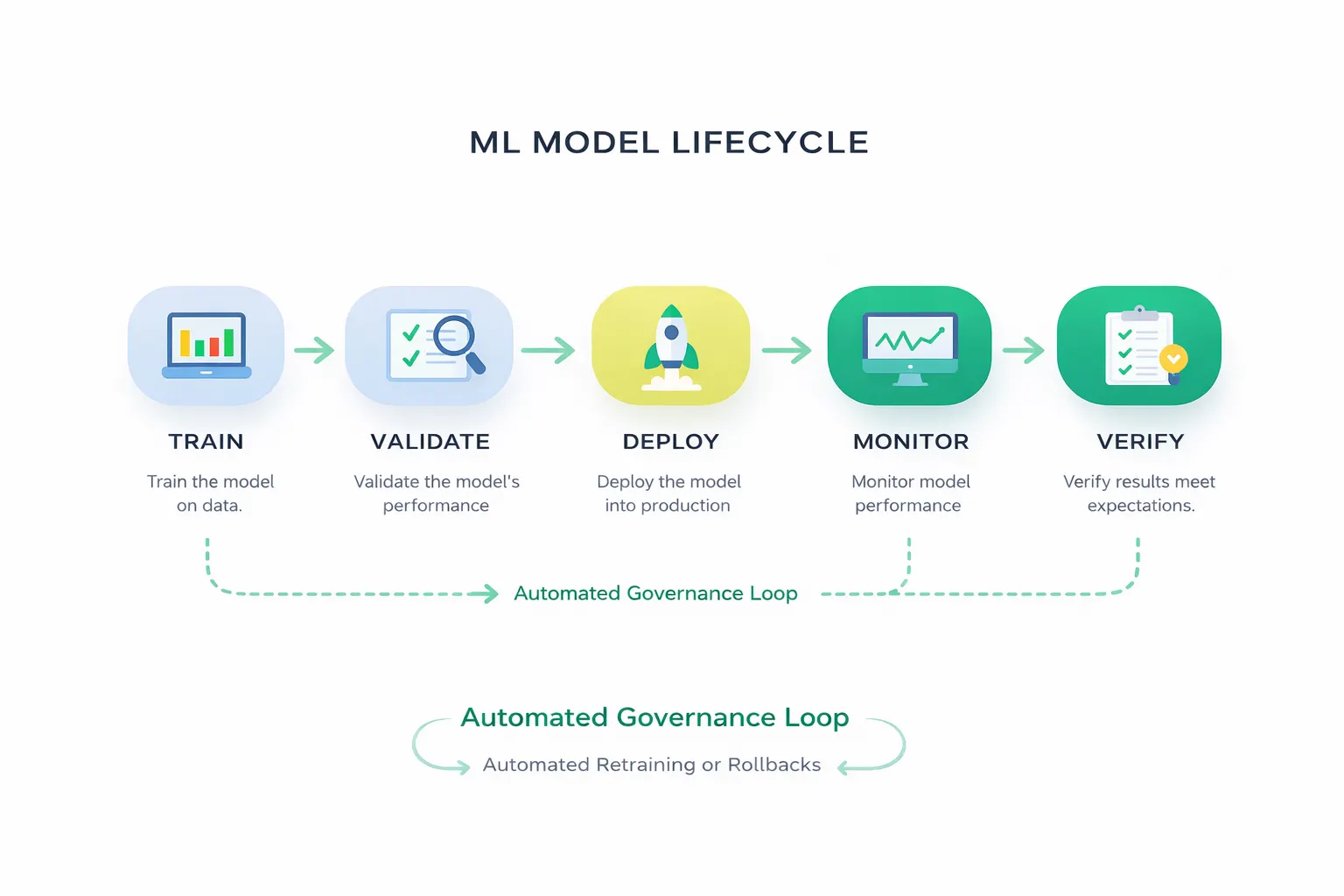
Automated ML Model Lifecycle
A Practical AI Governance Framework
Click each phase to explore the governance requirements:
1. Define Governance Policies
1. Define Governance Policies
- Clarify where AI is allowed
- Define acceptable risk levels
- Establish when human approval is required
2. Implement Continuous Monitoring
2. Implement Continuous Monitoring
- Track model performance
- Monitor data quality
- Observe system behavior and downstream impact
3. Manage the Model Lifecycle
3. Manage the Model Lifecycle
Treat models like software. This is the foundation of MLOps governance.
- Version everything (Data, Code, Models)
- Test before deployment
- Enable rollback and automated retraining
4. Add Human Oversight
4. Add Human Oversight
Not every decision needs a human. But high-impact ones always do.
- Approval checkpoints
- Escalation paths
- Override mechanisms
How we approach this at Tectome
We design AI systems with governance built in from the start.
- ✓Monitoring at both model and workflow levels
- ✓Safeguards to prevent cascading failures
- ✓Independent independent audit trails for every action
- ✓Defined boundaries for automated decisions
For example:
If an AI workflow triggers a multi-step process, each step is independently monitored and logged.
So if something fails, it’s contained not amplified across the system.
That’s the difference between automation and governed automation.
What’s Changing Next: The Era of AI Agents
AI agents make governance even more complex. They interact with tools, execute multi-step workflows, and make independent decisions. Errors spread faster.
These systems can:
- execute multi-step workflows
- interact with multiple tools
- make independent decisions
Which introduces new risks:
- errors spread faster
- behavior becomes harder to predict
- failures impact multiple systems
Future-ready governance will require:
- full action-level audit trails
- strict permission controls
- behavioral monitoring
- circuit breakers to stop failures in real time
Key Takeaway
- AI is not risky because it’s intelligent. It’s risky because it’s autonomous and often unmonitored.
- Most companies don’t fail at building models. They fail at controlling what those models do after deployment.
- If AI is part of your infrastructure, governance is not optional.
Final Thought
If your AI system makes decisions, triggers workflows, or interacts with real systems, then you’re not just building automation. You’re building something that needs control, visibility, and accountability from day one.
Get that right, and AI becomes a multiplier. Get it wrong, and it becomes a liability.
Want to build AI systems that don’t break in production?
If you're designing or scaling AI workflows and want governance built in from the start, we can help. We focus on building AI systems that are observable, controllable, and production-ready.
"AI is not risky because it's intelligent. It's risky because it's autonomous and unmonitored. Control is the true multiplier."


From our work
Read how we did this for…

Accelerate your roadmap with AI-driven engineering.
Click below to get expert guidance on your product or automation needs.