The Cost Problem in Agentic AI: Why Autonomous Workflows Get Expensive Fast
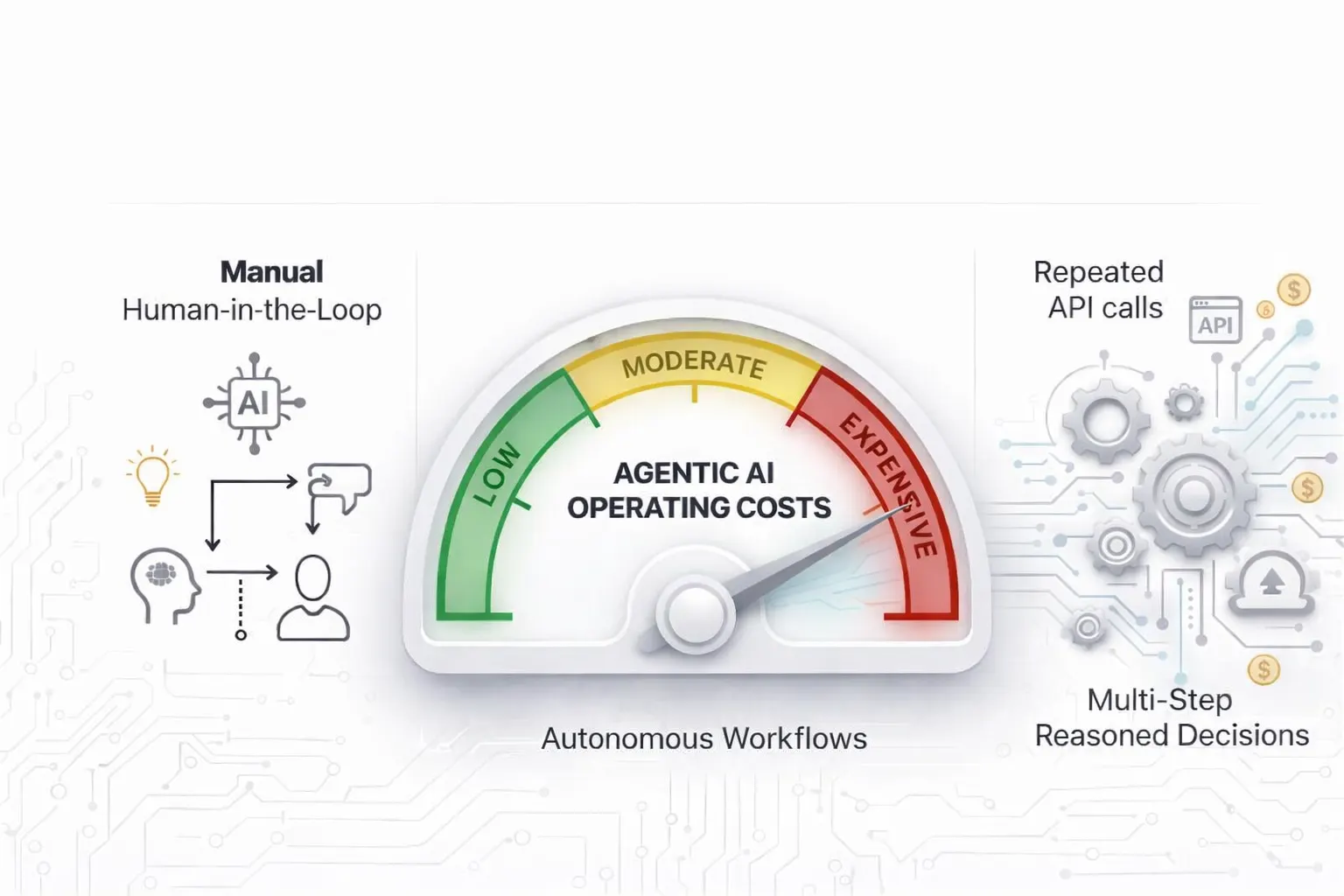
Agentic AI is a type of AI that can do more than answer questions. It can plan tasks, use tools, follow steps, check its own work, and keep going until a goal is complete. In business terms, that means it can help teams automate work that used to need multiple people, multiple systems, and a lot of manual follow-up.
That sounds efficient, but the cost picture is more complicated than it first appears. Once an AI system starts making repeated decisions, calling tools, storing context, checking outputs, and retrying actions, the price of running it can rise much faster than most teams expect.
SaaS solved the problem of buying software quickly. Agentic AI solves the problem of automating complex work. The new challenge is making that automation affordable, predictable, and sustainable at scale.
Why This Matters Now
Agentic AI is moving from experiments into real business operations, especially in support, IT, operations, analytics, and internal workflow automation. But unlike a simple chatbot, an agentic system may trigger several model calls, use external tools, hold memory, and run continuously, which creates a much bigger cost surface.
This is why many leaders are now asking a different question: not "Can we build an agent?" but "Can we afford to keep it running?"
Where Budgets Quietly Break
The budget usually breaks in the places teams do not model early enough. A simple workflow can become expensive once it starts chaining multiple reasoning steps, pulling more context, and verifying outputs before taking action.
The most common cost traps are:
Over-automation: A task that could be handled with rules is handed to a full agent.
Repeated model calls: Each decision step creates another billable event.
Always-on usage: The system keeps running even when human volume is low.
Poor workflow design: Agents automate messy processes instead of fixing the process first.
Weak governance: Failures and retries multiply the cost of each task.
Agentic AI deployments can involve $40,000–$200,000+ upfront and $5,000–$25,000 monthly in ongoing expenses depending on scale, architecture, and support requirements. AWS notes that agentic economics need a long-term view because workloads fluctuate and scale unevenly.
What the Market is Saying
- Some reasoning-heavy systems consume far more compute than earlier AI approaches.
- Workflow-heavy systems often need hybrid routing (cheaper models for simple tasks).
- Agentic AI economics are increasingly tied to observability, governance, and routing discipline.
- Enterprises that scale responsibly are more likely to use unified platforms and cost visibility.
Cost optimization is no longer a nice-to-have. It is a core design requirement.
What Leading Organisations Learned
IBM
IBM has reported major productivity impact from AI agents across enterprise operations, showing how agentic systems can create real value when deployed with clear business goals and operational discipline. The biggest gains happen when the system is designed around measurable outcomes rather than novelty.
View IBM Reporte& and IBM
e& and IBM announced an enterprise-grade agentic AI initiative focused on governance, risk, and compliance. A proof of concept delivered within eight weeks showed how agentic AI can operate at enterprise scale while staying aligned to compliance needs.
View Full ReportWhy Teams Underestimate Cost & How to Control It
Most teams compare an agent project against a simple software budget instead of a full operational model. They estimate the model cost, but miss recurring costs. A better way to think about it:
- Build cost: what it takes to launch.
- Run cost: what it takes to keep it useful.
- Scale cost: what happens when usage grows faster than the workflow matures.
The strongest systems are rarely the most autonomous ones. They are the most selective ones. Practical ways to keep costs under control:
- Start with the process, not the agent. Fix workflow logic before adding autonomy.
- Use the right model for the right task. Reserve expensive reasoning for high-value steps only.
- Limit the number of steps. Every extra turn increases cost and failure risk.
- Add evaluation gates. Check outputs before execution to reduce expensive mistakes.
- Measure cost per action. Track how much each completed workflow actually costs.
- Route simple work elsewhere. Use rules, RPA, or lighter automation where autonomy is unnecessary.
How Tectome Helps
Tectome can help teams avoid the most common agentic AI cost traps by mapping workflows before automation, identifying where autonomy adds value, and designing lighter systems where full agent behavior is unnecessary. That matters because many cost problems come from overbuilding rather than underbuilding.
For businesses, the practical value is simple: lower operational waste, fewer unnecessary model calls, better workflow design, and agent systems that scale without becoming budget problems.
Suggested Videos
IBM Orchestrate and Agentic AI
What is Google’s Agentic AI Strategy?
Build Agentic AI in Microsoft Copilot Studio
Key Takeaways
Agentic AI creates value, but it also creates new cost layers that traditional software teams often miss. The most expensive part is usually not the model itself; it is the full system around it.
Teams that win with agentic AI will not be the ones that automate everything. They will be the ones that automate selectively, measure relentlessly, and design for affordability from the start.
Ready to Optimize Your AI Strategy?
Don't let hidden agentic costs break your budget. Schedule an audit to scale safely.



Accelerate your roadmap with AI-driven engineering.
Click below to get expert guidance on your product or automation needs.