The AI DevOps Revolution: Automating Web Deployment Pipelines with Intelligence
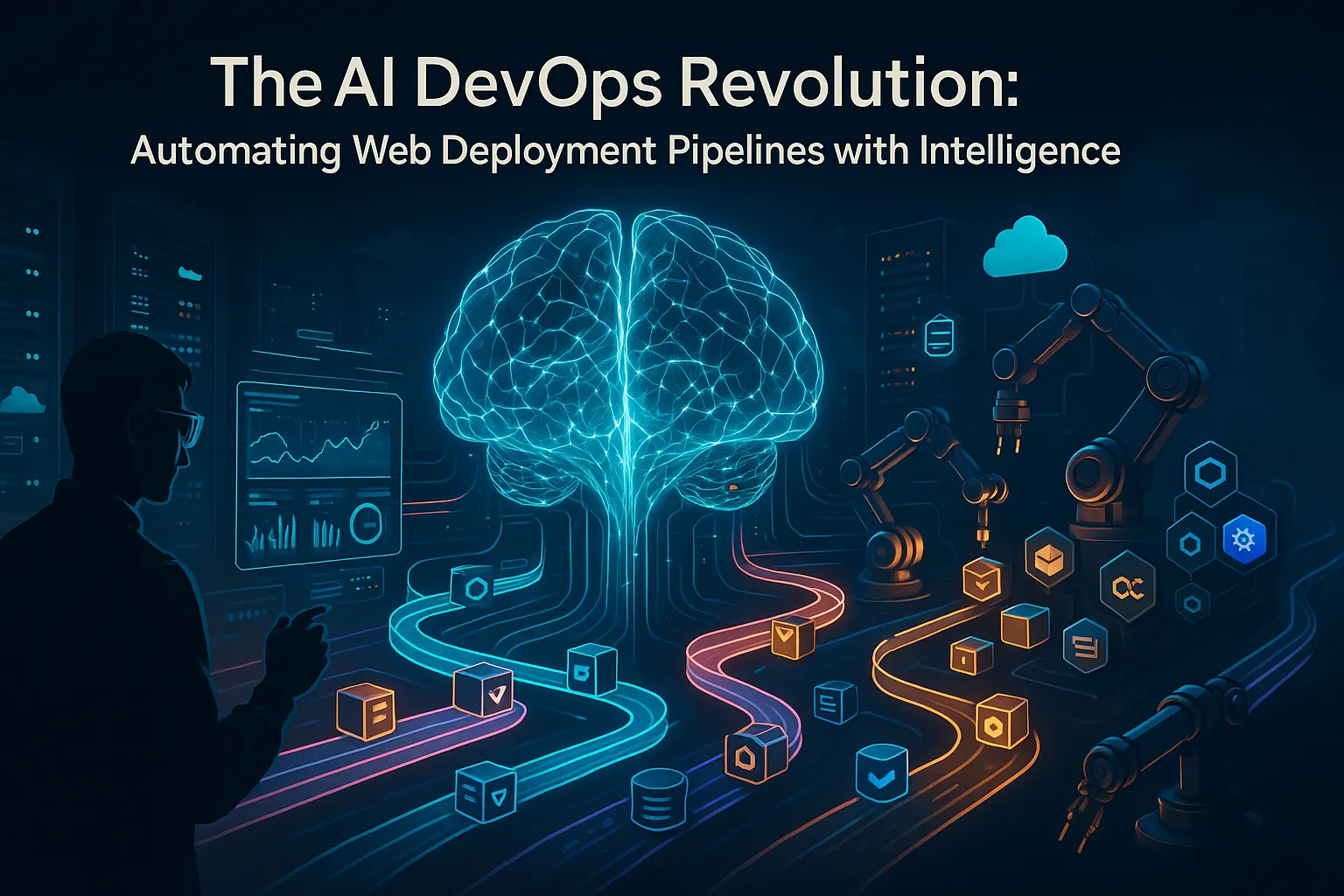
In the high-stakes arena of web development, where user expectations demand lightning-fast updates and zero downtime, traditional DevOps pipelines often feel like relics, clunky, manual, and prone to human error. Enter AI: the game-changer that's not just assisting but orchestrating your deployments. Tools like GitHub Copilot and Amazon Q Developer are slashing deployment times by up to 50% for teams optimizing their CI/CD workflows. Imagine a world where your full-stack React-Node.js app deploys to production with predictive anomaly detection, auto-remediation, and intelligent resource scaling, all without waking the on-call engineer at 3 AM.
This isn't sci-fi; it's the 2025 reality of AI-driven DevOps. Drawing from the latest trends, we'll explore how AI is revolutionizing web deployment pipelines, from automation basics to real-world setups. Whether you're a solo full-stack dev or leading a team at a scale-up, these insights will help you build smarter, faster, and more secure workflows. Let's dive in.
For a deep dive into AI's role in software delivery, check out the 2025 DORA State of AI-assisted Software Development Report, which highlights how 90% of developers now use AI, boosting task completion by 21%.
What is AI DevOps? The Shift from Reactive to Predictive
DevOps has always been about breaking silos between development and operations, but AI elevates it to intelligent DevOps, or AIOps, where machine learning anticipates issues before they erupt. In 2025, AI isn't bolted on; it's embedded, transforming pipelines from rigid scripts to adaptive systems that learn from every deploy.
Key trends shaping this revolution include:
- AI Agents for Cloud Engineering: These autonomous agents execute multi-step tasks, like provisioning AWS resources or debugging Kubernetes pods in your web app's deployment. Tools like Pulumi's Neo exemplify this, handling complex cloud interactions with human oversight for compliance.
- Predictive Analytics and Anomaly Detection: AI scans logs, metrics, and code in real-time, forecasting failures. For web devs, this means spotting traffic spikes in your Next.js API before they crash your Vercel edge functions.
- Governance Automation: AI enforces policies (e.g., security scans) without slowing velocity, using standards like the Model Context Protocol (MCP) for seamless LLM integrations.
The payoff? According to the 2025 DORA Report, high-performing teams using AI see 21% faster task completion and 25% larger pull requests, with elite performers achieving deployment frequencies up to daily.
For more on AIOps trends, see DevOps trends in 2025: From DevSecOps to AIOps.
Core AI Tools Turbocharging Your CI/CD Pipelines
The AI DevOps toolkit in 2025 is richer than ever, with a focus on open-source integrations and cloud-native smarts. Here's a curated selection of top tools, emphasizing those that automate web deployments. We've prioritized ones with direct CI/CD hooks for full-stack stacks (e.g., GitHub Actions, Jenkins).
| Tool | Key Features for CI/CD | Best For Web Devs | Time Savings Stat |
|---|---|---|---|
| GitHub Copilot | Real-time code suggestions for YAML pipelines; natural language to script translation; integrates with Actions for auto-generating deploy steps. | Writing Terraform for AWS S3 hosting or GitHub Actions for React builds. | 10.6% increase in pull requests. |
| Amazon Q Developer | Generates IaC templates (CloudFormation/Terraform); contextual debugging; agentic coding for pipeline optimization. | Automating Lambda deploys for serverless web backends. | 25% cut in development time for integrations. |
| AWS CodeGuru | ML-based code reviews in PRs; performance profiling for deploys; security vuln detection. | Optimizing Node.js APIs in CodePipeline for cost-efficient scaling. | 40% reduction in manual reviews. |
| Datadog | AI anomaly detection (Watchdog); root cause analysis; CI/CD monitoring integrations. | Real-time alerts on Vercel/Netlify deploys for frontend-backend sync. | 50% faster MTTR via auto-correlation. |
| Snyk | AI-prioritized vuln scanning in builds; policy enforcement. | Securing npm dependencies in GitLab CI for full-stack apps. | 2x faster issue fixes with exploitability scoring. |
| Jenkins with AI Plugins | Predictive failure analysis; smart test selection. | Legacy pipeline upgrades for enterprise web monoliths. | 30% slash in test time. |
These tools aren't isolated; they chain together. For instance, use Copilot to draft a pipeline, CodeGuru to review it, and Datadog to monitor the deploy, creating a self-healing loop for your web apps. Explore more tools in Top 12 AI Tools For DevOps in 2025.
Hands-On: Building an AI-Enhanced Web Deployment Pipeline
Let's get practical. We'll walk through setting up a GitHub Actions pipeline for a full-stack web app (React frontend, Node.js backend) using GitHub Copilot for automation. This example deploys to AWS ECS with auto-scaling, incorporating AI for code gen and anomaly checks.
Step 1: Generate the Pipeline YAML with Copilot
Fire up VS Code with Copilot extension. Prompt: "Create a GitHub Actions workflow for CI/CD of a React-Node app to AWS ECS, including tests, build, and deploy with Terraform." Copilot generates a comprehensive YAML workflow that handles testing (linting, unit tests with coverage), security scans via Snyk, Docker builds and pushes to Amazon ECR, and Terraform provisioning for ECS, all tailored for web optimization. Pro tip: Iterate with follow-up prompts like "Add predictive scaling based on CPU metrics" to infuse more AI smarts.
Step 2: Integrate AWS CodeGuru for Reviews
Hook CodeGuru into your PRs via AWS CodePipeline. It scans for inefficiencies, like unoptimized Express routes in your Node backend, suggesting fixes that cut latency by 20%.
Step 3: Monitor and Remediate with Datadog
Post-deploy, Datadog's Watchdog AI detects anomalies (e.g., 404 spikes from a bad route) and auto-triggers rollbacks via webhooks. Teams report 50% faster mean time to resolution (MTTR).
Deploy this pipeline, and your web app's release cycle shrinks from hours to minutes, scalable, secure, and intelligent.
Real-World Wins: Case Studies from the Trenches
These aren't outliers; 90% of DevOps teams now rely on AI daily, up 14% YoY.
E-commerce Scale-Up
A retail platform integrated GitHub Copilot with Jenkins, automating A/B test deploys for their Vue.js storefront. Result: Deployment frequency up significantly, with reduced cycle times. See the data.
FinTech Firm
Using Amazon Q Developer for IaC in GitLab CI, they embedded ML for fraud detection in backend deploys. Deployment time dropped 25%, aligning with DORA metrics for AI-assisted teams.
SaaS Startup
Datadog + Snyk in CircleCI pipelines caught vulns pre-deploy, reducing security incidents by 60% while maintaining daily releases. Read more in GitHub Copilot's impact at Zoominfo.
Challenges and Best Practices: Navigating the AI Hype
AI isn't a silver bullet. Challenges include:
- Data Privacy in Pipelines: LLMs like Copilot train on public code, vet suggestions for IP leaks.
- Over-Reliance Risks: AI hallucinations can introduce bugs; always human-review critical deploys.
- Adoption Barriers: 73% of teams aren't using AI in CI/CD yet, citing unclear use cases and lack of trust.
Best Practices
- Start Small: Pilot Copilot on non-prod pipelines.
- Layer Governance: Use MCP for secure AI-tool chaining.
- Measure DevEx: Track metrics like deploy frequency and MTTR to quantify ROI.
- Upskill Teams: Train on tools via free tiers, Copilot Workspace is a great entry point.
The Road Ahead: AI as Your DevOps Co-Pilot
By 2026, expect AI agents to fully own end-to-end deploys, with hybrid multi-cloud support becoming standard. For web devs, this means more time innovating on AI features (like RAG in your full-stack apps) and less on ops drudgery.
Ready to automate? Book a Tectome consult to AI-ify your pipelines. What's your biggest DevOps pain point, share in the comments! Follow us for more on AI full-stack trends.
- Cost-effective with free self-hosted options.
- Git workflow enables version control.


From our work
Read how we did this for…

Accelerate your roadmap with AI-driven engineering.
Click below to get expert guidance on your product or automation needs.