How to Choose an AI Development Agency (Without Getting Burned)
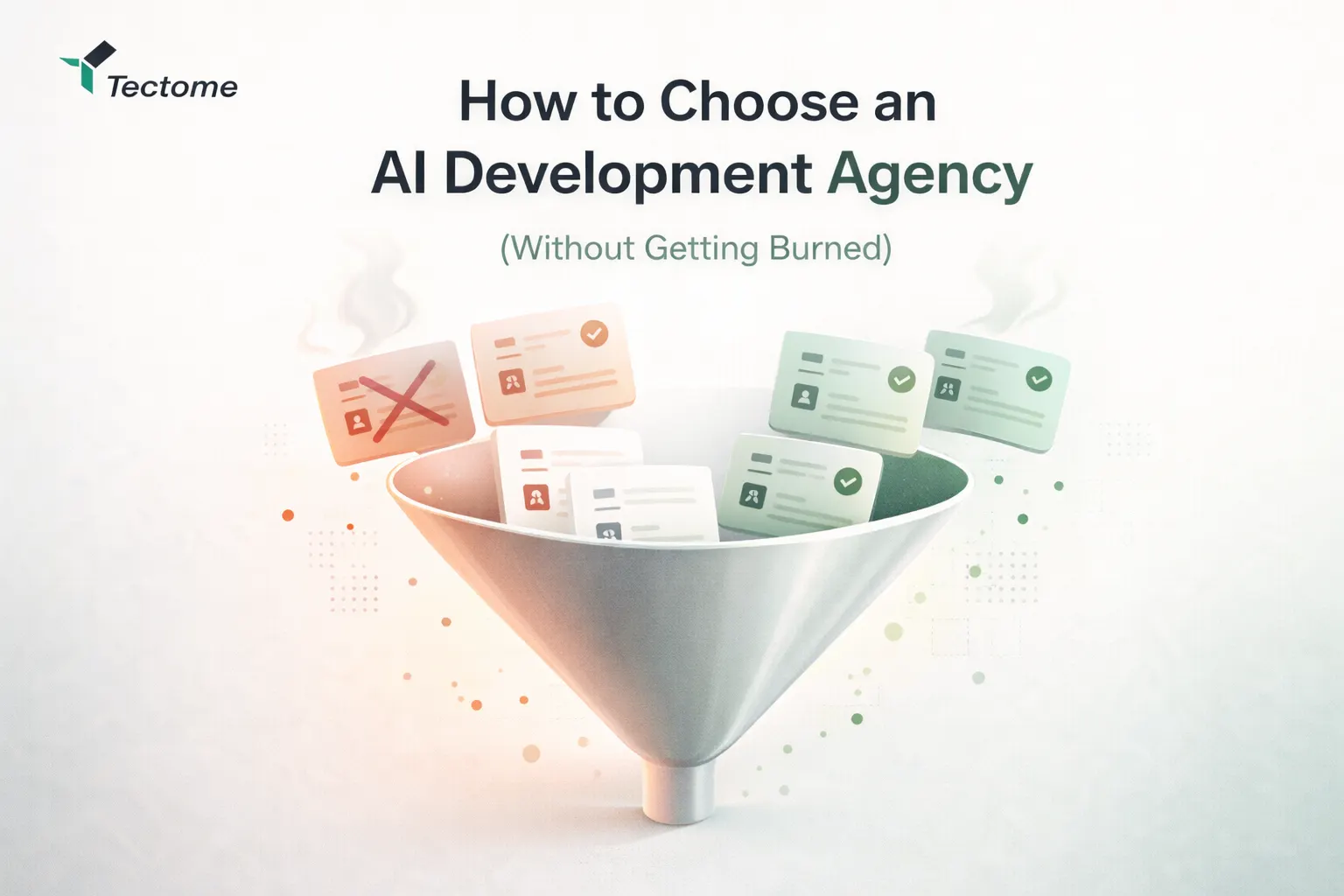
Most companies get burned by AI agencies because they evaluate on portfolio and price, not process and ownership.
Hiring an AI development agency is not like hiring a design studio or a marketing firm. The output is infrastructure it runs in production, handles real data, and either works when you need it or doesn't. Getting that choice wrong is expensive, disruptive, and often hard to reverse.
The agency evaluation process is broken. Most buyers look at case study slides, check a few LinkedIn profiles, and compare day rates. None of those signals tell you whether the agency writes production-ready code, who owns the IP when the engagement ends, or how they handle the messy realities of a live AI system six months post-launch.
This guide gives you the exact questions to ask, the red flags to walk away from, and a direct look at how Tectome answers each one.
Production-Ready Code
Clear IP Ownership
Post-Launch Support
The three things most agencies can't clearly answer but should.
7 Questions to Ask Before You Sign
Ask every agency on your shortlist these seven questions. Their answers and how quickly and confidently they give them will tell you more than any case study.
Do you write production-ready code or POC-only?
Many AI agencies are brilliant at demos and proof-of-concepts. Very few have the engineering discipline to write tested, observable, maintainable code that survives real traffic. Ask to see a repository. Ask about their CI/CD setup. If they struggle to answer, you're hiring a demo shop.
Who owns the IP and code when the project ends?
This should be non-negotiable. You should own 100% of the code, models, prompts, and data pipelines built for your project. Some agencies retain IP or licence the code back to you which means they can sell what they built for you to your competitors. Verify this is explicit in the contract, not just assumed.
Can I see a real system you built in production not a demo?
Demos prove nothing about engineering quality. Ask for a live system you can interact with, or a technical walkthrough of a production deployment monitoring setup, error handling, database schema, API design. If they redirect to a slide deck or a Loom of a prototype, that tells you everything.
How do you handle scope changes mid-project?
Scope will change. Requirements will evolve. A good agency has a clear, written process for handling change requests not a vague 'we'll figure it out.' Ask specifically: how is a scope change logged, priced, and approved? How does it affect the delivery timeline? The answer reveals whether they run a disciplined operation or a chaotic one.
What is your QA and testing process?
AI systems require more rigorous testing than standard software not less. Ask about unit tests, integration tests, load testing, and prompt regression testing. Ask who is responsible for QA a dedicated person or whoever is free that day. If the answer is 'we test at the end before handover,' treat that as a serious warning sign.
How do you handle model drift and AI maintenance post-launch?
AI models degrade over time as the real world diverges from training data. LLM APIs change, embeddings go stale, and retrieval quality drops without intervention. A serious agency will have a defined post-launch model monitoring process not just a support ticket queue. Ask what their standard monitoring and maintenance retainer looks like.
Can you work with our existing tech stack?
Beware agencies that insist on rewriting everything in their preferred framework. A competent agency integrates with what you have your existing databases, APIs, authentication systems, and deployment infrastructure. If they push back hard on your stack without a compelling technical reason, they may be optimising for their own convenience, not your outcome.
Red Flags to Watch For
Some signals are clear enough that they should end the conversation before it progresses further.
"We'll figure out the timeline once we get started" is not a plan. It is a signal that the agency either hasn't scoped the work properly or doesn't want to be held accountable to a schedule.
If the contract does not explicitly state that you own all IP, code, and assets produced during the engagement, assume you don't. Don't proceed until this is resolved in writing.
A portfolio full of polished slides and prototype videos is a marketing exercise, not evidence of engineering capability. Ask what percentage of their portfolio is running in production today.
If the agency can't describe their deployment pipeline or testing approach in specific terms what tools they use, how PRs are reviewed, how they handle rollbacks the code they ship will be fragile.
Genuine AI engineers have opinions. They use LangChain or LlamaIndex. They prefer pgvector over Pinecone for certain workloads. They have a deployment target. Vague answers like "we use the best tool for the job" without specifics indicate shallow technical depth.
Understanding Pricing Models
How an agency prices work shapes the incentives on both sides. Understanding the three main models helps you choose the structure that fits your project type.
| Model | How It Works | Best For | Watch Out For |
|---|---|---|---|
| Fixed-Price | Agreed deliverables at an agreed cost. Scope is locked. | Well-defined projects with clear requirements and stable scope. | Agencies may cut corners to protect margin if scope is underestimated. |
| Time & Materials | You pay for actual hours worked. Scope can flex. | R&D, exploratory AI work, or projects where requirements will evolve. | Costs can balloon without strong project governance and weekly checkpoints. |
| Retainer | A fixed monthly fee for ongoing capacity and support. | Post-launch AI maintenance, model monitoring, and continuous iteration. | Can become expensive for low-activity months. Ensure deliverables are defined. |
The pricing model matters less than whether it aligns incentives. Fixed-price works when scope is honest. T&M works when trust is high. Retainer works when the relationship is proven.
How to Evaluate a Proposal
A good proposal does more than list deliverables and a price. It demonstrates that the agency understood your problem, thought through the architecture, and has a plan for handing over something you can actually operate. Look for these five elements:
Architecture sketch
Even at proposal stage, a serious agency should be able to describe in specific terms how the system will be structured. What services, what models, what storage layer, how data flows. Vague references to 'an AI solution' are not architecture.
Clear, measurable deliverables
Each phase should have a defined output that can be accepted or rejected. Not 'AI integration work' but 'a working RAG pipeline over your document store with latency under 2 seconds and a documented evaluation suite.'
Testing plan
How will the agency verify the system works? This includes unit tests for individual components, integration tests across the full pipeline, and for AI specifically an evaluation framework for model output quality.
Handover process
What does the agency leave you with when the engagement ends? Documented codebase, deployment runbooks, monitoring dashboards, and a knowledge transfer session are minimum expectations. 'We'll hand it over when it's done' is not a handover process.
Assumptions and risks section
A proposal that lists no risks is one that hasn't been thought through carefully. Good proposals are honest about what is uncertain dependency on a third-party API, an unvalidated performance assumption, a data quality caveat.
How Tectome Answers These Questions
We hold ourselves to the same standard we ask clients to apply to every agency they evaluate. Here is how Tectome answers each of the seven questions directly.
Do you write production-ready code or POC-only?
Production-ready, always. Every project we ship includes automated tests, CI/CD pipelines, environment configuration, observability setup, and documented deployment runbooks. We do not hand over prototypes dressed as products.
Who owns the IP and code?
You do. 100%. All code, prompts, fine-tuned models, data pipelines, and documentation produced during your engagement are assigned to you in full at the close of the project. This is written into every contract before work begins.
Can I see a real system in production?
Yes. We can arrange a technical walkthrough of live systems we have built with client permission including architecture diagrams, monitoring dashboards, and code structure. We do not use demo environments as evidence of capability.
How do you handle scope changes?
Every scope change is logged, impact-assessed, and approved before it affects the timeline or budget. We use a formal change request process for anything beyond minor clarifications. Clients know the cost and impact before they decide.
What is your QA and testing process?
We write unit tests alongside code, run integration tests across full pipelines before delivery, and use LLM evaluation frameworks (including evals on a representative test set) for AI features. QA is a team responsibility, not a final-stage checkbox.
How do you handle model drift post-launch?
We build monitoring into every AI system we ship tracking latency, error rates, output quality metrics, and retrieval relevance over time. Our post-launch maintenance retainers include proactive drift detection, model version management, and quarterly performance reviews.
Can you work with our existing tech stack?
Yes. We integrate with your existing databases, APIs, authentication systems, and cloud infrastructure. We use TypeScript, Python, Next.js, FastAPI, PostgreSQL, and major cloud providers and we prefer extending what works over rewriting what doesn't.
Want to Ask Us These Questions Directly?
Book a 30-minute call with Tectome. Bring your shortlist questions, your requirements, and your scepticism. We'll answer all of it.
Key Takeaways
Evaluate AI agencies on process and ownership, not portfolio and price. Ask for production systems, not demos.
Code ownership must be explicit in the contract. If it isn't there in writing, assume it isn't yours.
Red flags like vague timelines, no testing culture, and inability to name specific tools indicate shallow engineering depth not a confidence gap.
Match the pricing model to your project type: fixed-price for defined scope, T&M for exploratory work, retainer for ongoing AI maintenance.
A good proposal includes an architecture sketch, measurable deliverables, a testing plan, a handover process, and an honest list of risks.
Related services
Ready to Choose the Right AI Agency?
Talk to Tectome. We'll walk you through exactly how we work, show you real systems we've built, and help you evaluate whether we're the right fit no sales pitch required.
From our work
Read how we did this for…

Accelerate your roadmap with AI-driven engineering.
Click below to get expert guidance on your product or automation needs.