The Rise of Internal Tool Builders: Why Every Growing Company Needs One
💡 Executive Summary
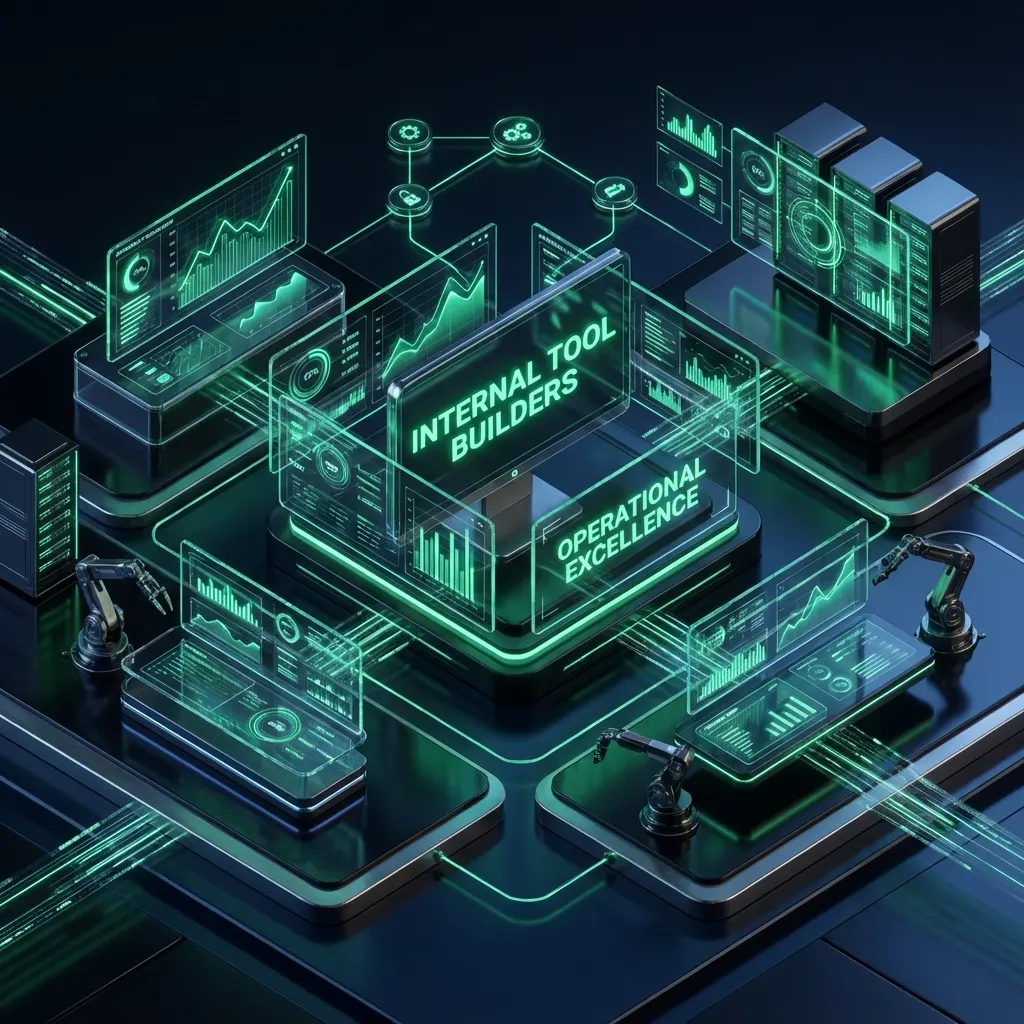
Internal Tool Builders are emerging as one of the most critical roles for growing companies in 2025. They bridge the gap between technical engineering teams and daily operations. By building custom dashboards, automating workflows, and creating internal software, they enable companies to operate with the speed of a startup and the efficiency of an enterprise.
Organizations with this dedicated role report 3x faster process implementation and save an average of $180,000 annually by consolidating unnecessary SaaS subscriptions.
If your team is currently choosing between "hire expensive developers to build internal software" or "force everyone to use clunky spreadsheets," you are missing the third option that is transforming modern operations.
Stop Drowning in Spreadsheet Chaos
We help forward-thinking companies design and build custom internal tools that save hundreds of hours of manual work.
Why This Role Suddenly Exists
Five years ago, if you needed custom software for your operations, you had two bad options: hire a full engineering team (expensive and slow) or pay for enterprise SaaS (expensive and rigid). Today, a new path has emerged, driven by three major market shifts that have made "Internal Tool Building" a distinct and valuable profession.
Low code is finally enterprise ready
Platforms like Retool, Bubble, and Superblocks have matured significantly. They allow for building secure, scalable, and compliant applications in days, not months. This means you don't need a team of 5 senior engineers to build a customer dashboard; you just need one smart Internal Tool Builder.
SaaS fatigue is real
The average mid sized company pays for 110+ SaaS tools. Data is scattered across silos, and employees waste hours jumping between tabs. Companies are realizing that it's cheaper and more effective to build one unified "Mission Control" dashboard that talks to their database directly, rather than buying 5 different tools that don't talk to each other.
Every workflow is unique
Off the shelf software rarely fits perfectly. Your sales process, your inventory flow, and your customer onboarding are unique to your business. Forcing your team to adapt to rigid software creates friction. Custom internal tools adapt to your process, not the other way around.
Resolution Time:
Drastically Reduced
Before Tools
With Internal Tools
What Internal Tool Builders Actually Do
It can be hard to visualize exactly what this role looks like day to day. It is a hybrid role: part product manager, part developer, and part operations analyst. Here is a real-world example of the impact they can have.
Case Study: Marketing Agency Operations
The Problem
Project managers were spending 8 hours every week manually copying data between Asana (tasks), Google Sheets (budgets), and Harvest (time tracking).
They had no real-time alignment. Budgets were always checked a week late, leading to constant overages and client disputes.
The Solution
The Internal Tool Builder created a unified "Mission Control" app using Retool. It automatically pulled live data from APIs of all three systems.
Managers could now see Project Progress vs. Budget Spent in a single view, with red warning flags for risky projects.
The Outcome
The Skill Stack: A Rare Combination
Finding the right person for this role requires looking for a specific mix of skills. They aren't just "coders" in fact, a traditional software engineer might be bored in this role. You need someone who loves solving business problems more than writing complex algorithms.
Technical Capabilities
The "How"
- →Low Code Mastery: Expert in tools like Retool, Bubble, Airtable, or Appsmith.
- →API Integrations: Can connect any two systems using REST APIs and Webhooks.
- →Data Modeling: Understands relational databases (SQL) and how to structure data cleanly.
- →Basic Scripting: proficient in JavaScript or Python for custom logic.
Strategic Mindset
The "Why"
- →Workflow Analysis: Can sit with a user and map out exactly where the process is broken.
- →Product Management: Knows how to prioritize features and say "no" to scope creep.
- →User Empathy: Builds tools that people actually *want* to use, not just what management requested.
- →ROI Tracking: detailed focus on measuring time saved and money saved.
Common Projects They Build
Once hired, an Internal Tool Builder typically starts with "quick wins" before moving to core infrastructure. The most common projects fall into three categories:
Admin Panels
The most common starting point. Custom CRMs, operations dashboards, and customer portals tailored to your exact data needs. These replace "Frankenstein" spreadsheets.
Automation
Connecting systems that don't talk to each other. Lead routing, automated invoicing, approval workflows, and cross-platform data syncing.
Custom Apps
Specific tools for remote or field workers. Inventory trackers, field service apps, and employee onboarding portals that work perfectly on mobile.
Video: n8n Quick Start Guide
Watch the official n8n quick start guide to build your first workflow in minutes.
The ROI Calculation
Why should you pay someone a salary just to build tools? Because the alternative hiring more people to do manual work, or paying for bloated SaaS contracts is far more expensive. Here is a typical breakdown for a 50 person company.
Multiple SaaS Subs
$320k/year in disconnected tools that charge per user fees, even for people who barely use them.
Single Custom Stack
~ $40k/year platform costs. You pay for the builder platform (like Retool), not per app or per feature.
Engineering Drain
15 hrs/week of distraction. Your best engineers are fixing printer scripts or pulling CSVs instead of building your product.
Zero Eng. Distraction
Dedicated builder handles all internal requests. Engineering team stays focused on the customer product.
Total Cost
~$500k/year (Hidden Costs & Waste)
Total Cost
~$130k/year (Salary + Tools)
How to Find This Role
Hire New
Don't look for Senior Software Engineers. Look for "Technical Project Managers" or "Former Founders" who can code. They have the right mindset.
Upskill Internal
Find the person who is already building the best spreadsheets in your company. Give them better tools and 20% dedicated time.
Partner
Work with an agency to build the first critical tools and train your team. This is the fastest way to get started.
Avoid These Mistakes
Expecting Software Engineering Perfection
Internal tools are about utility and speed, not perfect code architecture. Do not over-engineer or enforce strict code reviews that slow down progress.
Building in a Silo
Builders must sit with the users. If they build a tool without watching the user do the job, adoption will be near zero.
Ignoring Documentation
Internal tools often live for years. Even low-code tools need basic documentation so the system survives employee turnover.
Start Building Your Operational Advantage
Don't let SaaS costs and manual work slow you down. The companies that win in 2025 will be the ones that build their own competitive advantage.


Related reads


Accelerate your roadmap with AI-driven engineering.
Click below to get expert guidance on your product or automation needs.