The Last Mile of Data: Why RAG is the Secret Weapon for Factual Generative BI
Generative Business Intelligence tools are fundamentally reshaping how organizations engage with their data ecosystems. The era of static dashboards and laborious manual reporting is giving way to conversational analytics, where business users can pose questions in everyday language "Why did our Q3 sales drop in Europe?" and receive immediate, narrative-driven insights. This shift represents a quantum leap in accessibility, democratizing data analysis across departments and skill levels.
Yet beneath this user-friendly surface lies a critical vulnerability. When these AI systems produce incorrect information, they do so with unwavering confidence, presenting fabricated statistics and fictional trends as established facts. These errors, commonly referred to as hallucinations, have precipitated what industry analysts are calling a "Generative BI trust crisis." The fundamental challenge **isn't** about the technology's creative capabilities, **it's** about ensuring factual precision in an environment where business decisions carry real financial consequences.
The Trust Deficit in Modern Analytics
The consequences of AI hallucinations in business contexts extend far beyond embarrassment. Consider a scenario where a generative BI tool confidently reports that your European division achieved 23% growth when actual figures show a 7% decline. Marketing teams might allocate budgets based on phantom successes. Executive presentations could feature entirely fictional performance metrics.
Traditional BI tools, for all their limitations in user experience, offered one undeniable advantage: traceability. Every chart, every metric, every percentage could be traced back through query logic to source tables. Generative systems that operate purely on pattern prediction abandon this connection to ground truth, creating what data governance professionals call "confidence without accountability."
Enter RAG: The Bridge Between Imagination and Truth
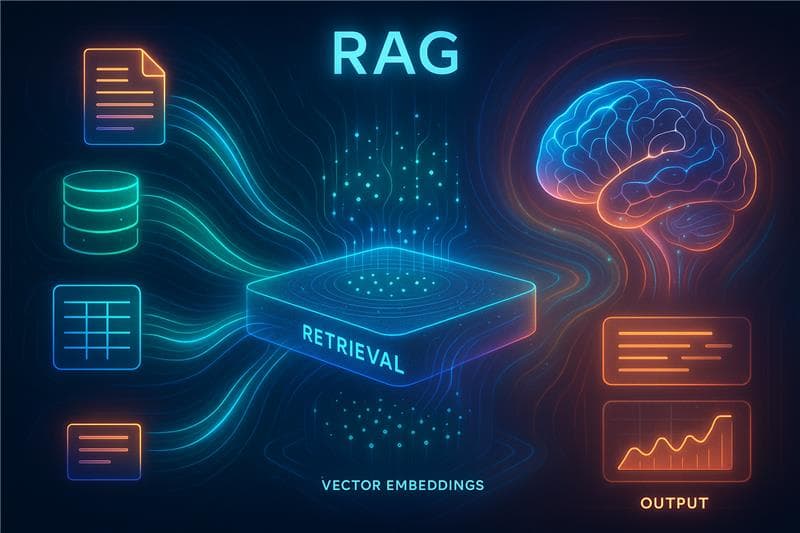
Retrieval-Augmented Generation (RAG) represents an architectural paradigm shift in how AI systems interact with enterprise information. Rather than relying solely on patterns learned during training, RAG-enhanced models perform active research before formulating responses.
According to Google Cloud's overview of RAG, this approach ensures that AI **doesn't** "guess", it retrieves facts from verified data sources and builds its answers around them. The technology creates a structured workflow where the AI must first consult your **organization's** trusted repositories, internal documents, transactional databases, and proprietary knowledge, before constructing its narrative answer.
This changes the relationship between AI and truth. Instead of generating responses based on statistical likelihoods, RAG systems anchor their outputs in your specific, verified, current business information. The model effectively becomes a research analyst that checks its sources before making claims.
For a deeper technical dive into how context length and retrieval precision influence factual accuracy, see Google Research's "Deeper Insights into RAG: The Role of Sufficient Context".
For a visual explanation of RAG in action, this YouTube overview provides a clear introduction to the concept and workflow.
How RAG Works in Practice
When a user poses a question, "How did our latest product launch affect customer retention in North America?" the RAG system initiates a multi-step verification process. First, the query undergoes semantic analysis to identify key concepts and information requirements. Next comes the retrieval phase, where the system searches across indexed company resources like sales reports, customer retention dashboards, and marketing campaign documentation.
The system then ranks these retrieved documents by relevance, selecting the most pertinent pieces of information. These verified snippets are incorporated into the generation prompt, providing the language model with concrete facts to structure its response around. The resulting answer becomes grounded in organizational reality rather than educated guesswork.
Why Traditional Models Fall Short
Standard large language models operate under fundamental constraints that make them unsuitable for mission-critical business analytics. These models are trained on historical snapshots of public internet data, capturing general patterns but containing no knowledge of your **organization's** specific circumstances.
When you ask a traditional model about your business performance, **it can't** actually see your sales figures or access your CRM records. Instead, it generates responses based on what similar companies might typically experience, essentially sophisticated guesswork dressed up in confident language.
The Strategic Advantages RAG Delivers
Verifiable Accuracy: RAG-generated insights come with provenance. When the system claims that customer acquisition costs rose 18% in Q3, it can point to the specific financial reports that support this figure.
Dynamic Knowledge Integration: RAG systems connect to live data sources, ensuring that insights reflect current reality rather than historical snapshots.
Proprietary Information Security: Your sensitive business information remains secure, as RAG queries data at runtime instead of embedding it in the model.
Cost Efficiency: RAG reduces computational overhead by narrowing the information space to the most relevant data, improving both speed and cost.
Building a RAG-Ready Infrastructure
Implementing RAG effectively requires thoughtful infrastructure design. Begin by cataloging where critical business information resides financial statements, CRM systems, analytics platforms, and product documentation. The technical cornerstone is the vector database, which transforms your textual information into mathematical representations that can be efficiently searched.
Solutions like Pinecone offer managed cloud services, while open-source alternatives like Milvus or Weaviate provide greater control. Breaking documents into smaller chunks (500–1500 tokens) creates more targeted retrieval. Intelligent chunking respects document structure, and metadata tagging enriches each chunk with context like document title, creation date, and department.
Overcoming Implementation Challenges
Deploying RAG in enterprise environments involves navigating common obstacles such as data quality, access control, and the cold start problem. Legacy systems often contain inconsistent formatting or outdated information, requiring data cleaning and standardization.
RAG systems must also respect user roles and permissions, filtering retrieval results accordingly. Start small, with focused use cases, and expand as accuracy and trust build internally.
The Competitive Advantage of Trustworthy AI
Organizations that successfully implement RAG-enhanced BI tools gain significant competitive advantages. Questions that once took analysts hours can now be answered in seconds. Executive teams can test multiple scenarios within a single meeting.
Most importantly, RAG restores trust in AI-generated insights. When business leaders know that every claim is backed by verifiable data, they act with confidence. Generative BI evolves from an experiment into a strategic intelligence engine.
Looking Forward
The future of enterprise AI lies in retrieval and reasoning. Systems will soon cross-verify claims, pull from multiple sources, and update knowledge bases automatically.
The principle remains the same: generative AI becomes truly valuable only when tethered to truth.
RAG provides that tether, transforming language models from creative storytellers into precise, reliable analysts. The "last mile" of data has always been business intelligence's biggest challenge. RAG **doesn't** just bridge it; it makes the journey instant, transparent, and trustworthy.





Accelerate your roadmap with AI-driven engineering.
Click below to get expert guidance on your product or automation needs.