SEO Survival Guide 2026: GEO Has Replaced Traditional SEO
Quick Answer
Executive Summary
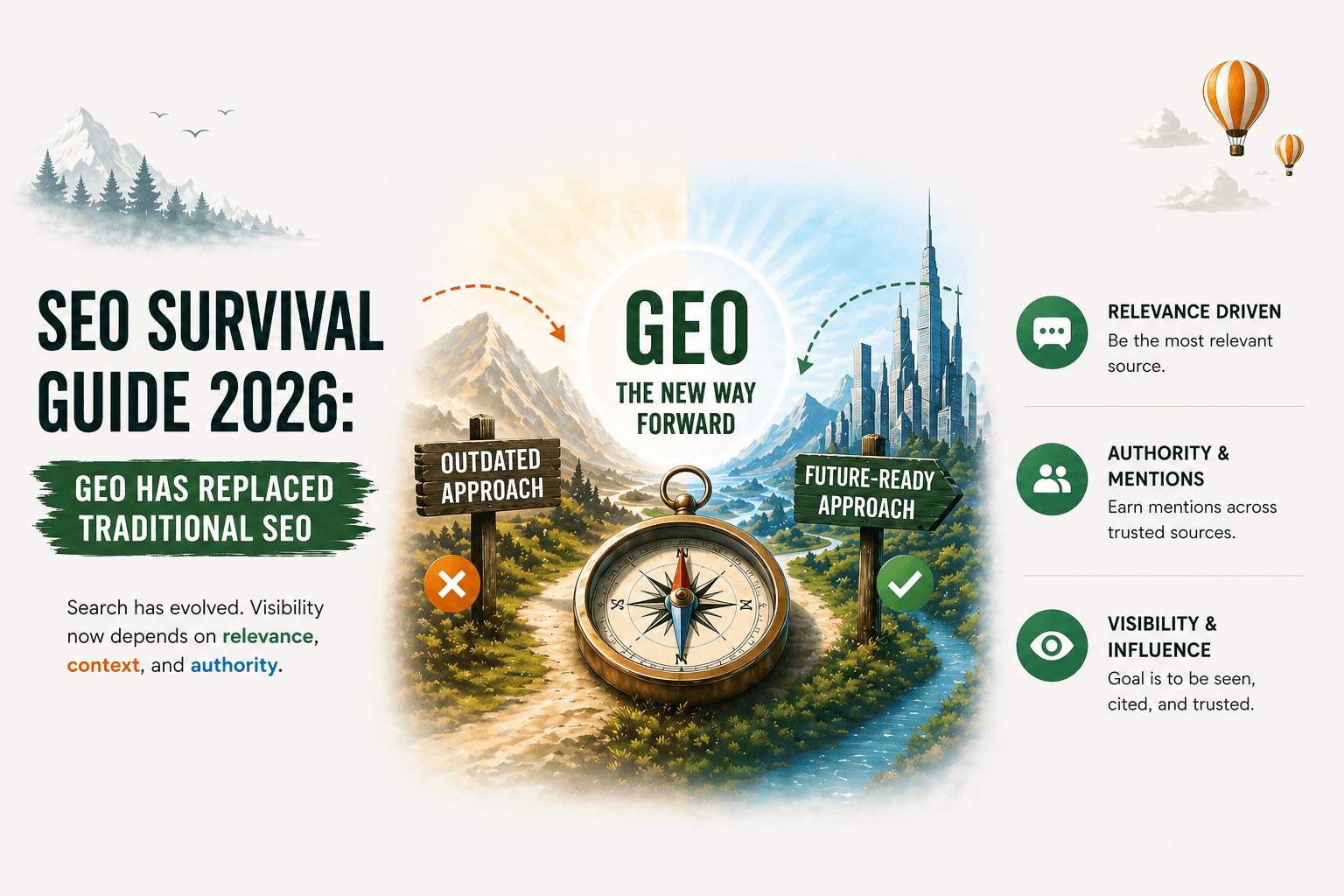
"Generative Engine Optimization" (GEO) has replaced traditional SEO. It pays no attention to keyword density. It ranks based on Information Gain. Does your content provide a new unique perspective, data point, or insight that the AI hasn't read elsewhere?
🛡️ Is Your Traffic at Risk?
Get a free "AI Search Readiness" audit. We simulate how SearchGPT and Gemini see your top 5 pages.
Get My AI AuditThe most terrifying graph in marketing right now isn't about ad costs or social media reach. It's the decline of "Blue Link Click-Through Rate."
For 20 years, the deal was simple: You write content, Google indexes it, and users click your link to read the answer.
That deal is broken.
With the rise of SearchGPT, Perplexity, and Google Gemini, users aren't looking for links anymore. They're looking for answers. And the AI is giving it to them directly on the search page.
The New Rules of the Game: SEO vs. GEO
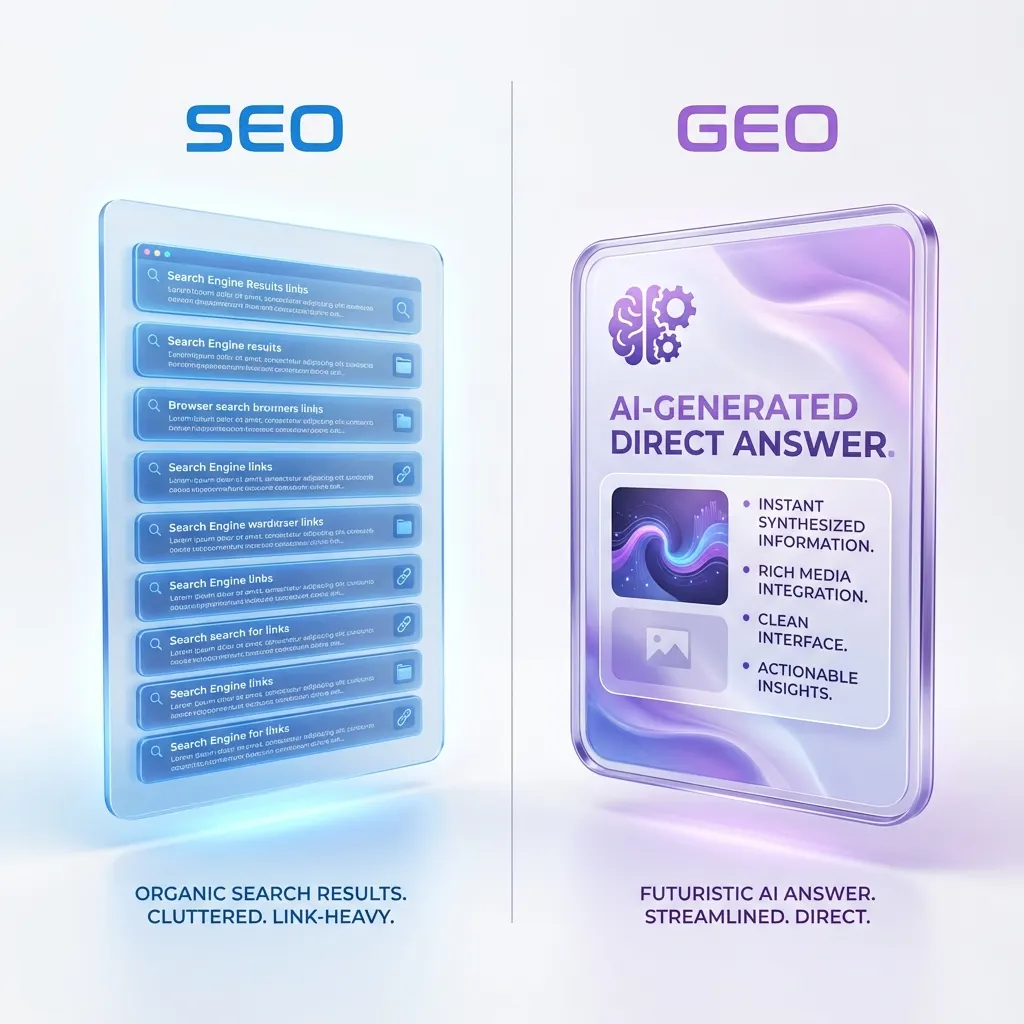
We are shifting from Search Engine Optimization (SEO) to Generative Engine Optimization (GEO). Here is the difference:
| Feature | Old SEO (Google 2023) | New GEO (AI Search 2026) |
|---|---|---|
| Goal | Rank #1 for a keyword | Be cited as the source |
| Content Length | Longer is better (2000+ words) | Concise, data-rich is better |
| Keywords | Include in H1, H2, first 100 words | Entities and semantic clusters |
| Success Metric | Traffic / Pageviews | Share of Voice / Brand Mentions |
Strategy 1: Optimize for "Information Gain"
Google filed a patent years ago for "Information Gain Scores," and now it's the primary filter for AI models.
What does this mean? It means the AI asks: "Does this document tell me something I didn't already know from the other 1,000 documents on this topic?"
How to add Information Gain:
- Original Research: Run a survey (even a small one) and cite the % stats. AI loves stats.
- Contrarian Takes: Go against the grain. "Why everyone is wrong about X."
- Personal Experience: Use phrases like "In our experience deploying this for Client X..." AI cannot hallucinate your personal memories (yet).
Strategy 2: The "Zero-Click" Funnel
Accept that 60% of users will never visit your site. They will get the answer from the AI snapshot and leave.
Does this mean marketing is dead? No. It means you need to optimize for Brand Salience.
You want the AI to say: "According to [Your Brand], the best way to do this is..."
Case Study: The "Branded Concept" Strategy
We helped a SaaS client coin a new term for their methodology: "Revenue Operations 2.0."
We wrote the definitive guide on it. Now, when you ask ChatGPT "What is Revenue Operations 2.0?", it cites our client 100% of the time.
↗ Result: 200% increase in high-intent demo requests, despite 0% increase in generic traffic.
Strategy 3: Structured Data is Your API to the AI
AI models are hungry for structure. If you give them a blob of text, they have to guess. If you give them Schema Markup (JSON-LD), you are spoon-feeding them the answer.
In 2026, your technically optimized FAQs, How-To schemas, and Organization markup are more important than your meta descriptions.
Is Your Content Invisible to AI?
Most websites block AI scrapers without realizing it, or have structure that confuses LLMs.
Book an AI-Readiness Technical ReviewThe 2026 Checklist
If you do nothing else this week, do these 3 things:
Add Data
Update your top 10 posts with at least one unique statistic or data point.
Focus on "Why"
AI answers "What" and "How" perfectly. It struggles with "Why" and "Should I?". Pivot.
Own a Term
Invent a name for your unique process. Teach the AI that you are the definition.
Adapted from our internal guide: "Surviving the Intelligence Age"


From our work
Read how we did this for…

Accelerate your roadmap with AI-driven engineering.
Click below to get expert guidance on your product or automation needs.