Serverless First: Rethinking Conventional Cloud Infrastructure
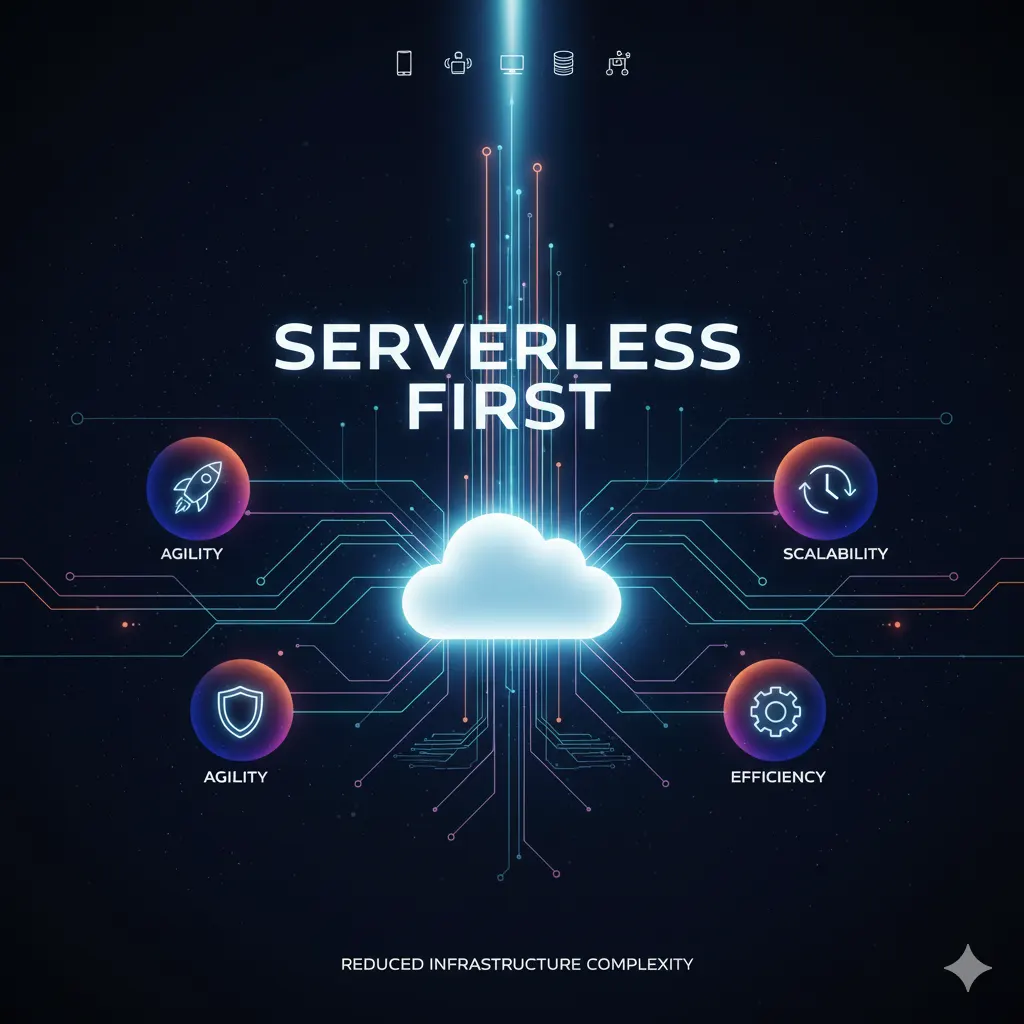
In 2025, the "Serverless First" architectural style is speeding up application development, allowing smaller teams to create durable, highly scalable apps that were formerly the purview of IT giants. Developers can fully avoid server provisioning, management, and patching by adopting Backend-as-a-Service (BaaS) and Function-as-a-Service (FaaS). Focus 100% on the features and 0% on the infrastructure. This is the basic core value proposition.
The Economics: Pay-Per-Execution to Idle Spending
The disruptive cost model of serverless architecture is its strongest justification.
Removing Idle Capacity
In conventional cloud configurations, you have to pay for a server all the time, even when **it's** not in use, to make sure it can manage any surges in traffic. On the other hand, serverless functions only bill you for the precise amount of compute time needed during execution, which is frequently expressed in increments of 100 milliseconds. Only when your code is executing do you have to pay.
Decreased Operational Overhead
Organisations may significantly cut their DevOps staff and effort by contracting out server administration, patching, load balancing, and operating system maintenance to cloud vendors like AWS Lambda, Azure Functions, and Google Firebase.
Cost Proof
Running a function 2 million times a month can cost as little as $0.20 due to the generous free tiers and millisecond billing. See AWS Lambda Pricing Explained for a detailed breakdown.
The Velocity Advantage: Immediate Deployment and Scalability
For agile teams and quick product iterations, serverless architecture is ideal.
Elastic Scalability
Serverless functions are scalable by nature. Without human involvement, they automatically scale from processing one request per hour to one million requests per minute (a viral traffic spike). The possibility of downtime brought on by unforeseen traffic is eliminated by this inherent elasticity.
Quicker Time-to-Market
Developers may quickly implement modest, isolated modifications thanks to the decoupled, function-based architecture. Large, monolithic deployments and intricate build procedures are not required, which significantly speeds up the release cycle for new features and issue fixes. (Check out Azure Functions Quickstart to see how quickly a function can be deployed.)
Video Walkthrough: Serverless Architecture Explained
To truly grasp the power and use cases of FaaS, watch this short crash course:
The Trade-offs Between Security and Performance
Serverless offers additional technological considerations despite its many benefits.
Provider Lock-in vs. Elevated Accessibility
The trade-offs inherent in serverless architectures require specific strategies for mitigation. The benefit of Elevated Accessibility comes with the drawback of provider Lock-in, as BaaS platforms are closely linked to their **provider's** ecosystem (e.g., AWS vs. Google), making migration challenging. The mitigation strategy for this is to use open-source frameworks like Terraform or Serverless Framework to abstract the deployment logic.
The Cold Start Issue
The Decreased Edge Latency of serverless is sometimes hindered by The Cold Start Issue, where the system needs time to initialize its environment for the first request, causing a latency spike. To mitigate this, developers must employ provided concurrency to keep crucial, user-facing tasks "warm" and prepared for immediate execution.
Debugging Complexity
Finally, while serverless offers Integrated Security, its scattered and transient nature makes Debugging Complexity a major drawback, as developers lack direct backend visibility. The mitigation is to make significant investments in observability, logging, and tracing technologies created especially for serverless environments. This need for robust tooling is proven by the experience of large enterprises, as demonstrated in the New York Times case study on large-scale cloud migration challenges.
In Conclusion
By 2025, serverless and BaaS will be the standard design for all new web and mobile applications. Businesses can out-innovate rivals who are still burdened with operating traditional server infrastructure by adopting this paradigm, which also offers them significant financial benefits and a velocity advantage.
Related reads

Runbooks, Not Random Scripts: Building Automation Infrastructure That Doesn't Collapse at Scale
By Mohammed Hariss, 25 Mar. 2026
From SaaS Chaos to Composable Control: Rethinking Internal Platforms.
By Hariss, 14 Apr. 2026

The Rise of AI Agents:Why Businesses That Ignore Them Will Fall Behind
By Tectome, 25 Sept. 2025


Accelerate your roadmap with AI-driven engineering.
Click below to get expert guidance on your product or automation needs.