AI Development for SaaS: What to Build and What to Buy
SaaS companies that ship AI see 2–4× higher net revenue retention.
SaaS companies that ship AI features see 2–4× higher net revenue retention. The companies falling behind aren't slower builders they're building the wrong things.
The pattern is consistent: AI-powered onboarding drives faster activation, in-product AI assistants increase daily usage, and automated churn signals give customer success teams the lead time they need to intervene. None of these require training a frontier model. Most can ship in weeks using existing API infrastructure.
higher net revenue retention for SaaS products with AI features
of SaaS churn is detectable in advance with usage pattern analysis
The question isn't whether to add AI to your SaaS product. It's which AI features will actually move retention metrics and which are table stakes your competitors have already shipped.
4 Ways to Add AI to Your SaaS Product
These four approaches consistently deliver measurable impact on activation, engagement, and retention and each maps to a different part of the product lifecycle.
AI-Powered Onboarding
Personalises the setup experience based on user profile, role, and use case. Instead of a generic wizard, new users follow a path tailored to their specific goal. Reduces time-to-value from weeks to hours.
Weeks → Hours to first valueIn-Product AI Assistant
A Copilot-style feature that answers questions about the user's own data inside your product. Users stop leaving to search for answers elsewhere. Drives daily active usage by making the product the system of record for decision-making.
Increases daily active usageAutomated Customer Success Alerts
Detects churn signals usage drop, rising support ticket volume, feature non-adoption before the customer churns. Routes alerts to the right CSM with context and suggested actions attached.
Detect churn before it happensAI-Generated Insights from User Data
Weekly automated summaries, anomaly detection, and trend reports generated from your users' own data inside the product. Turns raw activity into clear recommendations. Makes the product feel proactive rather than passive.
Turns product data into user valueBuild vs API: How to Choose
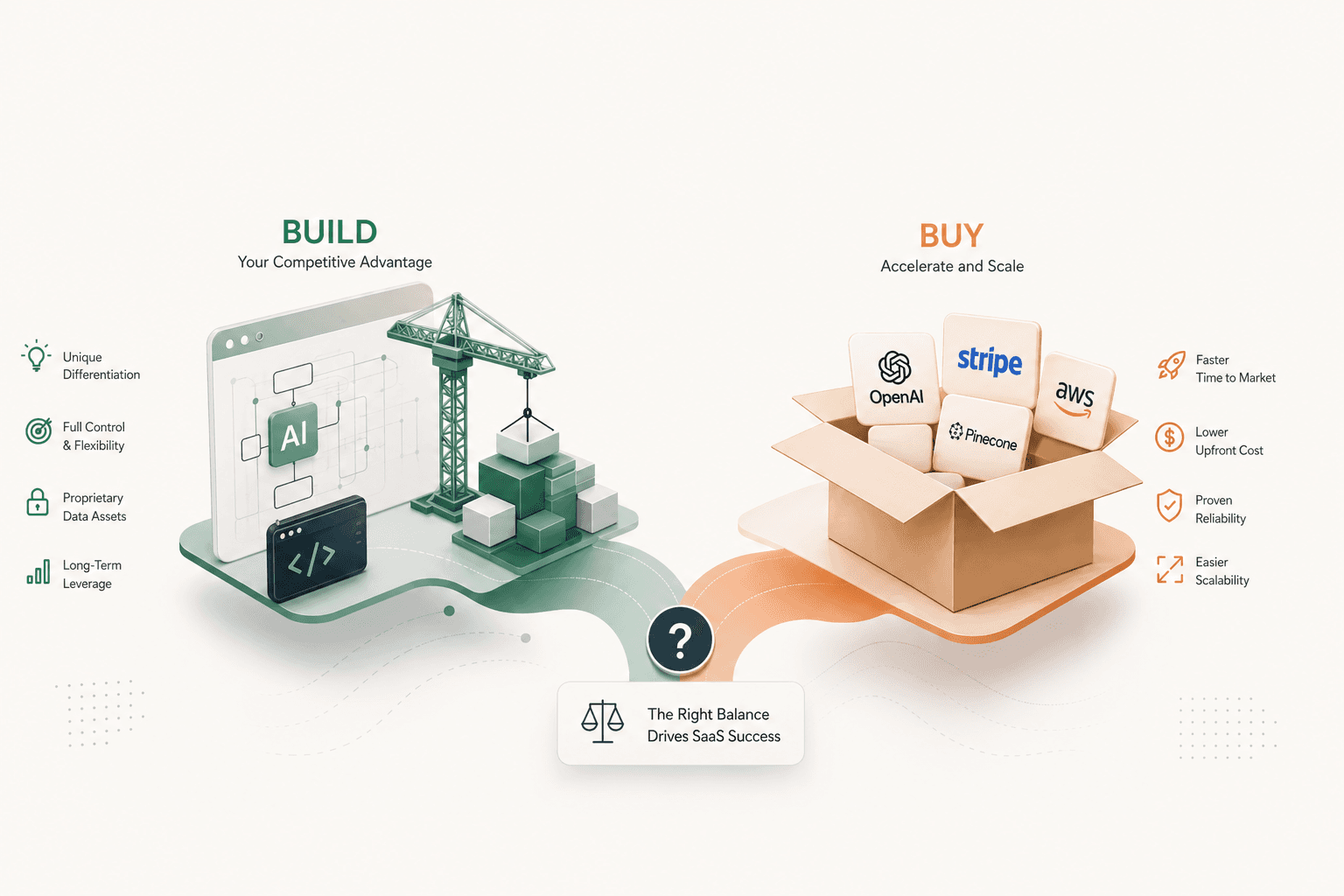
Most SaaS teams face the same question: use OpenAI or Anthropic's API, or invest in a custom or fine-tuned model? The answer depends on whether you need speed-to-market or long-term competitive differentiation.
OpenAI / Anthropic API
- Fast to ship 4–8 weeks
- Lower upfront cost: £10–50k
- Loses differentiation if competitors do the same
- Dependent on third-party pricing and uptime
Best for: shipping fast, validating AI features before deeper investment
Fine-Tuned / Custom Model
- Genuine moat when trained on proprietary data
- Higher performance on domain-specific tasks
- Slow to build: 3–6 months
- Higher investment: £50–150k
Best for: core product differentiation where proprietary data is the advantage
The practical approach: Start with API-based features to validate the use case and build user familiarity. Once you understand exactly how users interact with the AI capability and have proprietary interaction data, evaluate whether a fine-tuned model makes economic sense.
How AI Reduces Churn
AI reduces SaaS churn through three distinct mechanisms. Each operates at a different point in the customer lifecycle.
| Mechanism | How AI Helps | Lifecycle Stage |
|---|---|---|
| Improved Activation | Personalised onboarding gets users to their first 'aha' moment faster, reducing early churn before it starts. | Onboarding |
| At-Risk Account Detection | Usage pattern analysis identifies disengaged accounts weeks before contract renewal, giving CSMs time to intervene. | Retention |
| Increased Engagement | AI-generated insights and in-product assistants make users return daily the product becomes indispensable rather than optional. | Expansion |
The compounding effect matters. A SaaS product that improves activation, detects at-risk accounts, and drives daily usage is attacking churn at every stage simultaneously not just patching one leak.
Case Study: TrainED
TrainED Scalable Multilingual AI Assessments
TrainED needed a scalable learning platform that could deliver multilingual AI-powered assessments, personalise course recommendations, and automate the operational overhead of managing a growing user base. Tectome built the interactive learning platform with automated course recommendations and AI-powered assessment logic that scaled without adding headcount.
Multilingual AI
Assessment type
Significantly reduced
Ops overhead
Ahead of schedule
Delivery
Read the full TrainED case study"They shipped our platform faster than we expected and the automation they built has cut our ops overhead significantly."
Cost to Build AI Features
Cost varies significantly depending on whether you're adding an API-based feature or building a custom AI capability for core product differentiation.
API-Based AI Feature
Integrating OpenAI or Anthropic APIs to add chat, summarisation, recommendations, or basic automation. Fast to validate, easy to iterate.
Custom AI for Core Differentiation
Fine-tuned models or purpose-built AI pipelines trained on proprietary product data. Builds a genuine competitive moat. Suitable once the use case is validated.
AI Feature Maintenance Retainer
Monitoring, model performance reviews, prompt iteration, and incremental improvements. Keeps AI features accurate and up to date as usage patterns evolve.
Note on pricing: These ranges reflect typical engagements for SaaS companies building meaningful AI features not simple chatbots. Scope, data complexity, and integration depth all affect final cost. A scoping call is the fastest way to get an accurate estimate for your specific product.
Key Takeaways
SaaS companies with AI features see 2–4× higher net revenue retention the gap between AI-enabled and non-AI products is widening.
The four highest-impact AI features are personalised onboarding, in-product AI assistants, automated churn alerts, and AI-generated insights from user data.
Start with API-based features to validate fast at £10k–£30k. Invest in custom models only once you have proprietary data and a proven use case.
AI reduces churn across the full lifecycle improving activation, detecting at-risk accounts, and driving daily engagement simultaneously.
Maintenance matters. AI features degrade without ongoing monitoring. Budget £2k–£4k/month for retainer support from launch.
Ready to Ship AI Features That Actually Retain Users?
We'll scope the right AI features for your SaaS product and give you a clear build plan API-based or custom with honest timelines and costs.
Related reads
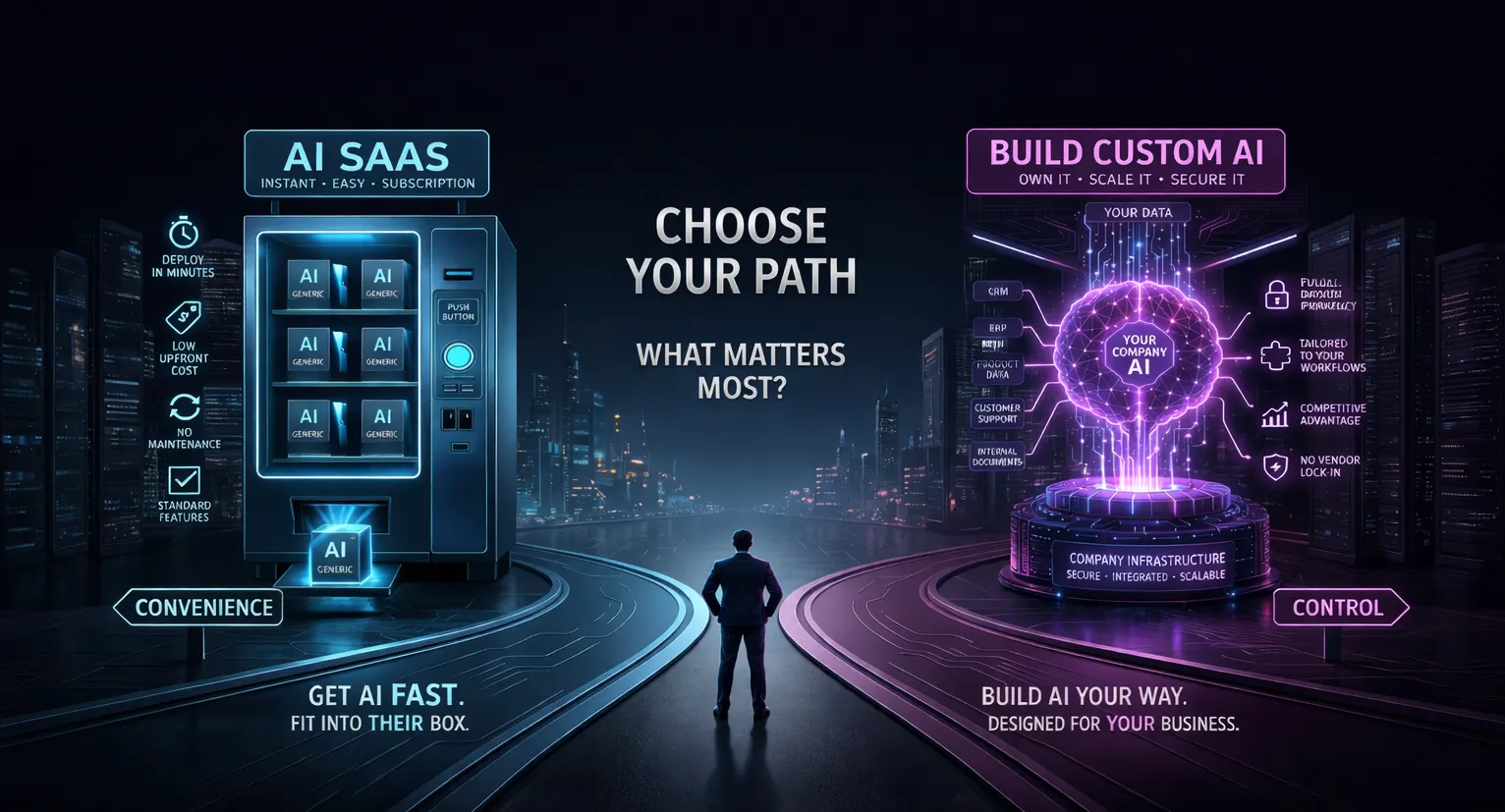
Build vs Buy: When to Build Custom Internal Software Instead of Buying SaaS
By Divyanshu Sharma, 31 Mar. 2026
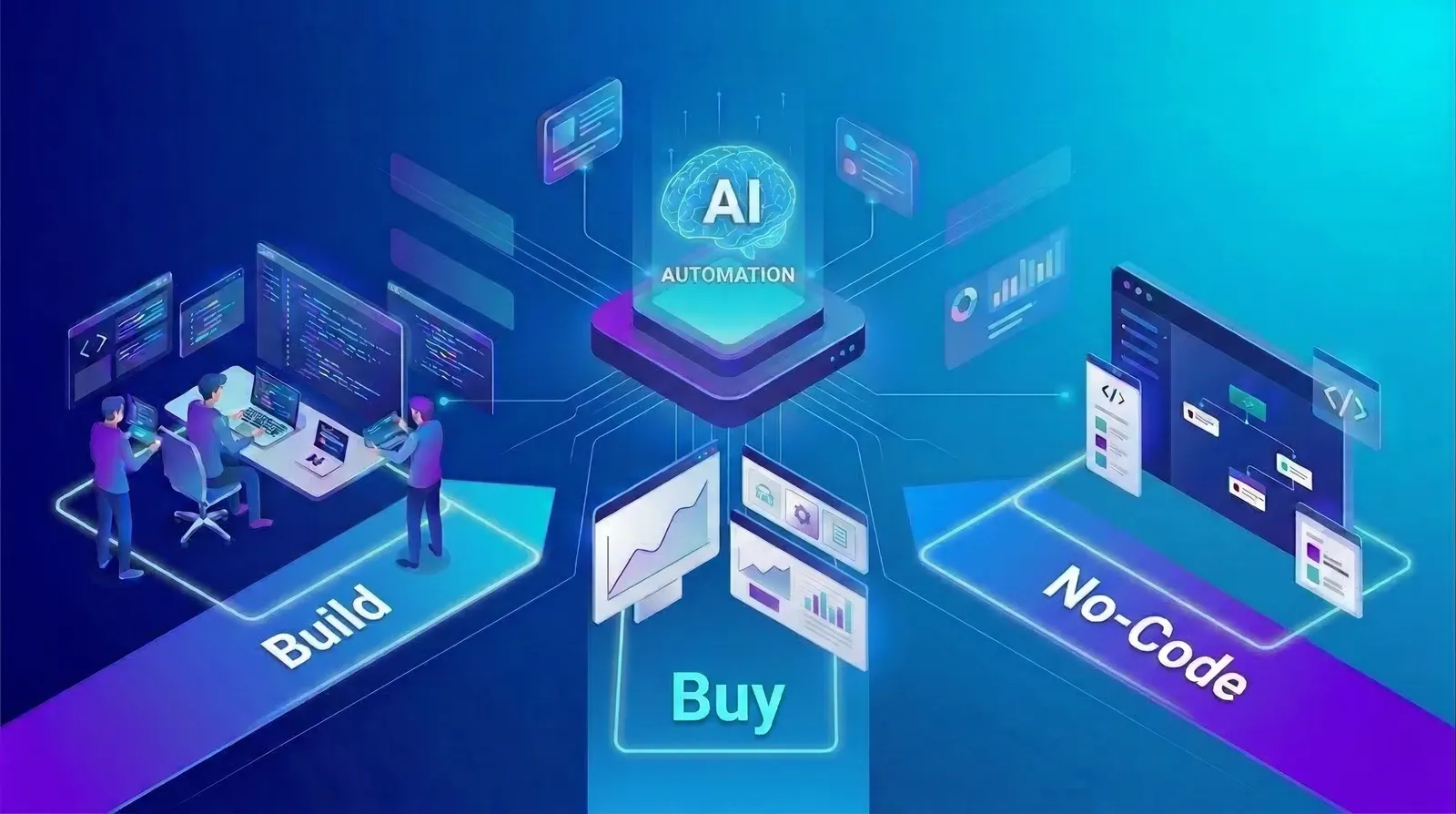
Build vs Buy vs No-Code: How Companies Choose the Right Automation Strategy in 2026
By Lakshay, 10 Mar. 2026
How to Choose an AI Development Agency (Without Getting Burned)
By Kartik Anand, 08 Apr. 2026
From our work
Read how we did this for…
Accelerate your roadmap with AI-driven engineering.
Click below to get expert guidance on your product or automation needs.