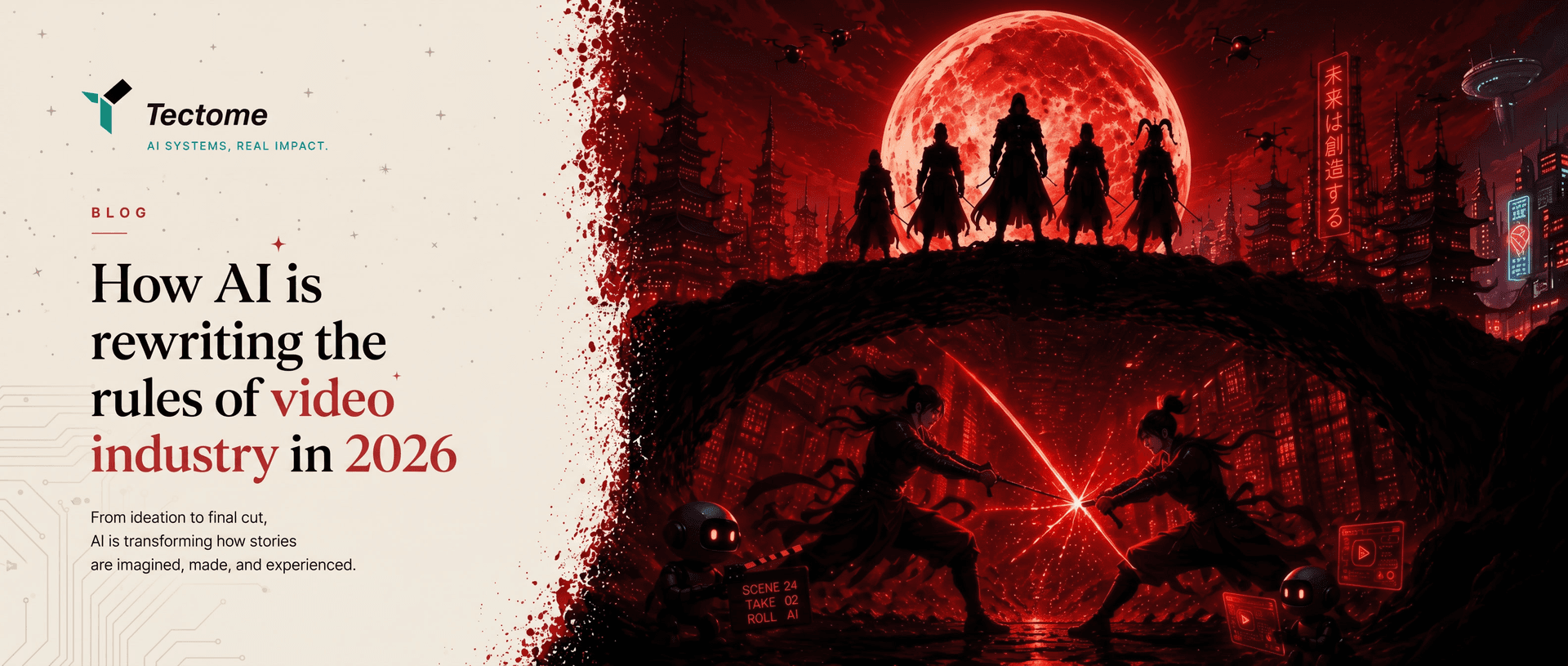
How AI is rewriting the rules of the video industry in 2026
Two years ago, producing a high quality brand video meant hiring a director, camera crew, editors, lighting teams, and renting locations for days at a time. Production timelines stretched across weeks. Revisions meant reshoots. Even testing a new concept carried real cost.
That production model is changing fast.
AI video has moved beyond experimental clips and novelty demos into something far more practical: a production layer that brands, agencies, and creative teams are already using in real workflows.
At Tectome AI, we've been building inside this shift from the beginning. We work across AI systems, automation, and generative workflows, and AI video has become one of the fastest moving parts of that stack. The clips included throughout this article are not placeholders or stock examples. They are outputs from real production workflows and client facing campaigns.
The Leap That Changed Everything
To understand how quickly this category has evolved, you need to look at where it was not very long ago.
In early 2025:
most AI video outputs were short
motion often broke under pressure
characters drifted between shots
lip sync was inconsistent
cinematic control barely existed
The technology was impressive from a research perspective, but it was difficult to use in professional production.
By 2026, the situation looks very different. The leading models now support:
higher-resolution outputs suitable for commercial work
structured multi-shot sequences
more natural motion and body language
integrated audio generation in some workflows
stronger camera control and scene composition
The important shift is not that AI video became perfect. The important shift is that it became usable. That changes the economics of production entirely.
The Models Reshaping the Industry
Different models are good at different things. There is no single "best" system right now. Production quality comes from understanding where each model performs well and combining them correctly.
Google Veo 3.1
Veo is one of the strongest models right now for realism, natural movement, and dialogue-heavy scenes. It performs particularly well when:
- facial motion matters
- scenes need believable body language
- cinematic framing is important
For narrative-style content and premium ad visuals, Veo is one of the most reliable systems currently available.
Kling 3.0
Kling became one of the most important releases in AI video because it pushed multi-shot consistency further than most competing systems. Its strengths include:
- structured sequences
- consistent subject framing
- cinematic motion across shots
For ad creatives and short-form storytelling, this matters more than raw visual fidelity alone.
Runway ML
Runway remains one of the best tools for creative control. We use it when projects require:
- controlled camera movement
- detailed adjustments
- scene refinement
- motion editing workflows
Rather than functioning purely as a generation model, Runway sits closer to a professional creative tool.
Seedance 2.0
Seedance has become particularly interesting for narrative-driven scenes where audio and visuals need to feel connected. Instead of treating sound as a separate layer added afterward, the system generates:
- dialogue
- ambience
- environmental response
within the same generation process. That creates outputs that feel more cohesive immediately.
OpenAI Sora 2
Sora helped push broader awareness of AI video into the mainstream. Its strength has always been:
- strong visual interpretation
- dynamic scene generation
- prompt responsiveness
However, the platform's product direction has shifted significantly in 2026, making it less central to long-term production pipelines compared to tools that are currently evolving more aggressively.
The Platform Connecting Everything: Higgsfield
One of the biggest workflow problems in AI video is fragmentation. Different models excel at different tasks: one handles realism better, another handles motion better, another performs better for structured sequences. Moving between systems repeatedly slows production down.
That is where Higgsfield becomes useful. Instead of functioning as a single video model, Higgsfield acts as a production layer across multiple systems.
It allows teams to:
compare outputs side-by-side
switch models inside one workflow
manage scenes more efficiently
reduce iteration friction
For production environments, this matters more than most people realize.
What Makes Higgsfield Different
Most AI video tools focus entirely on generation. Higgsfield focuses on workflow structure. Its Cinema Studio environment is built around: scene sequencing, shot planning, camera control, and cinematic framing, rather than isolated clip generation.
For teams producing narrative sequences or ad campaigns, this changes how production is approached. Instead of generating disconnected clips and stitching them together later, workflows become more scene-oriented from the start.
The Bigger Shift Most People Miss
From Visuals to Operations
Most discussions around AI video focus on visuals. The more important shift is operational.
Traditional Production
AI Production
That difference matters because iteration speed changes creative decision-making. Brands are no longer limited to one version of an ad, one creative direction, or one final edit.
Now teams can generate multiple variations, test different hooks, iterate based on engagement, and adapt campaigns quickly. This is why AI video matters beyond aesthetics.
Work We Have Produced
Most articles about AI video stay theoretical. We prefer showing output. The examples below are built from real workflows.
1. Fashion Campaign

Fashion Agency Campaign
By Pradhuman Singh
This campaign was produced entirely using AI-generated video. The brief required editorial-style visuals, cinematic movement, and a premium fashion aesthetic.
We combined multiple systems for consistency and refined the final output in post-production. Turnaround time was under 30 minutes.
2. Performance Ad Creative

Anime Performance Concept
By Pradhuman Singh
A high-energy anime fight sequence built for paid social. Fast cuts, dynamic motion, and bold visual language designed to stop the scroll.
The goal was simple: maximum impact in under 10 seconds.
3. Narrative Sequence
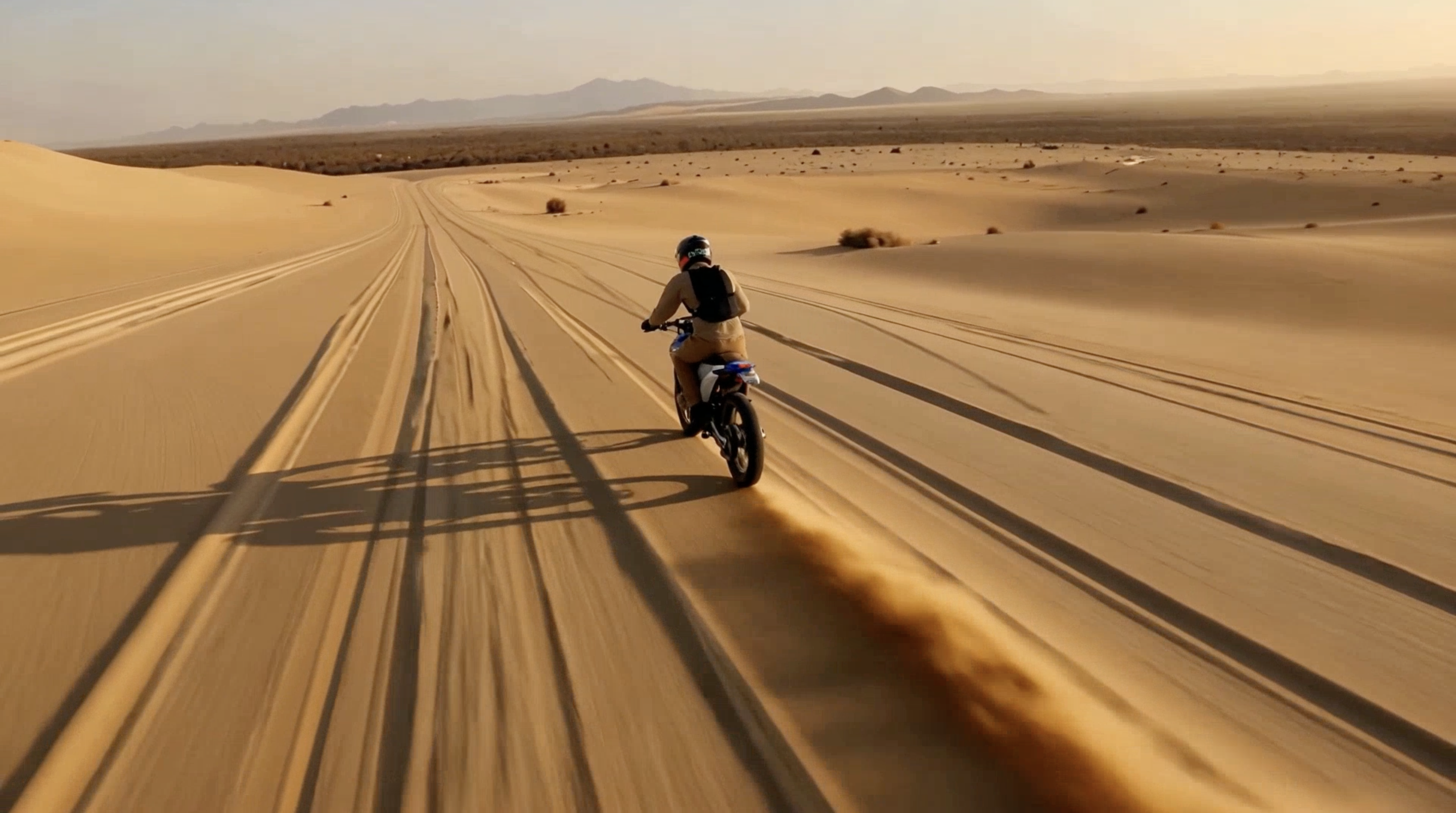
Cinematic Narrative Exploration
By Pradhuman Singh
A first-person bike ride captured with a cinematic eye. Movement, light, and pace come together to create an immersive visual story.
Raw footage, purposeful framing letting the journey speak for itself.
AI Inside the Tools Editors Already Use
The shift is not limited to standalone AI platforms. Traditional editing software is also being rebuilt around AI-assisted workflows.
Adobe Premiere Pro now includes generative B-roll, dialogue enhancement, and smart reframing.
DaVinci Resolve continues expanding AI-assisted masking and subject tracking.
Platforms like Descript and OpusClip automate transcription, clipping, formatting, and social adaptation.
The result is not just faster editing. It is a compression of repetitive production work.
The Job Market Is Already Changing
One of the biggest misconceptions around AI video is that it removes creative work. In practice, it changes the value of different skills.
The most valuable people now combine:
The demand for AI-native creative production is already visible across freelance platforms, marketing agencies, startup teams, and internal brand studios. The people benefiting most are the ones learning these workflows early.
What AI Video Still Cannot Do Reliably
Despite the progress, important limitations still exist.
Long-form consistency
Maintaining perfect character continuity across long sequences remains difficult.
Complex physics
Crowd scenes and detailed interactions can still break.
Cost at scale
Video generation remains compute-heavy, especially across large production volumes.
These limitations are real. But compared to where the technology stood even twelve months ago, the pace of improvement is unusually fast.
What This Means for the Future
The video industry in 2026 is not a story about AI replacing creativity. It is a story about production becoming more accessible, iterative, and scalable. Small teams can now produce content volumes that previously required large production infrastructure.
Creative workflows are becoming faster. Testing cycles are becoming shorter. The advantage is shifting from pure production capability toward creative judgment, iteration speed, workflow design, and strategic execution.
Work With Tectome AI
We build AI systems, automation workflows, and generative production pipelines designed for real-world use. If you are exploring how AI fits into your marketing, content, or product workflows, we would be happy to talk.
Accelerate your roadmap with AI-driven engineering.
Click below to get expert guidance on your product or automation needs.