Multi-Agent AI Teams: How to Orchestrate Multiple AI Agents Without Losing Control
Quick Answer
Executive Summary
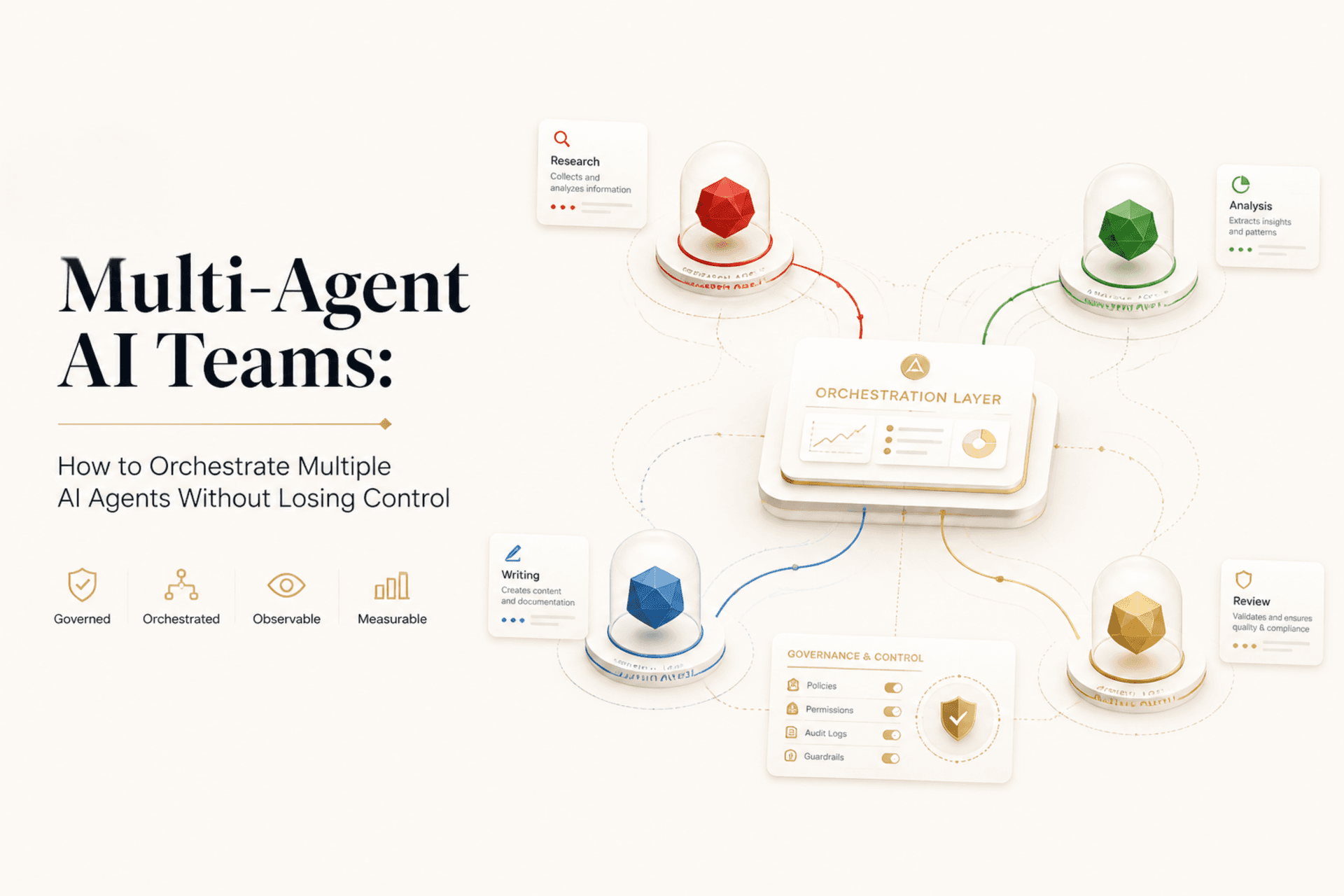
A single AI agent trying to handle everything is like hiring one generalist to do the job of an accountant, a lawyer, a data analyst, and a customer success manager simultaneously. The breadth kills the depth. The answer is not a better single agent, but a team of specialized, accountable agents coordinated by an orchestration layer that keeps the whole system from going off the rails.
The Single Agent Problem Nobody Talks About
You built an AI agent. It works brilliantly in demos. It summarises documents, drafts responses, queries your CRM. Then you give it a real business workflow, one that spans four systems, requires three types of judgement, and needs to handle edge cases your team invented over years of experience.
It hallucinates. It drops context halfway through. It gets stuck.
This is not a model quality problem. It is an architecture problem. A single agent trying to handle everything is like hiring one generalist to do the job of an accountant, a lawyer, a data analyst, and a customer success manager simultaneously. The breadth kills the depth.
The answer, increasingly, is not a better single agent. It is a team of agents, each specialised, each accountable, coordinated by an orchestration layer that keeps the whole system from going off the rails.
This is multi-agent AI, and in 2026 it has moved from research concept to production reality. Here is what you actually need to know to build it without losing control.
What Multi-Agent Orchestration Actually Means
Multi-agent orchestration is the practice of coordinating multiple AI agents so they can divide work, communicate results, and complete tasks together that none of them could complete alone.
Think of it the way you would think of conducting an orchestra. Each musician plays a different instrument with unique capabilities. The conductor does not play every instrument, they coordinate timing, balance, and collaboration to create something no individual musician could achieve alone.
In a business context, a financial reporting workflow might involve one agent querying transaction data, a second applying regulatory classification, a third checking policy compliance, and a fourth producing formatted output. Each step depends on prior outputs. Each step requires different tooling and domain context. Orchestration is the engineering pattern that makes this extensible and reliable.
The key distinction from single-agent systems: agents in a multi-agent setup do not wait for each other unless sequencing genuinely requires it. A research agent and a data-retrieval agent can run concurrently. The orchestrator collects their outputs and passes them to a synthesis agent. Total elapsed time is closer to the duration of the longest single task than the sum of all tasks combined.
Orchestration is the foundational pattern that makes these systems compound and remain stable over time. For a deeper architectural breakdown of these system coordination layers, read the Atlan Guide on Multi-Agent System Orchestration.
The Three Orchestration Patterns (and Where Each Breaks)
There are three dominant patterns for structuring how agents interact. Choosing the wrong one does not just slow you down, it creates failure modes that are genuinely difficult to debug in production.
Supervisor / Worker
A central supervisor routes tasks to specialist worker agents and synthesises results. This is the most intuitive pattern and the easiest to reason about. The supervisor is the single point of accountability; workers execute without needing to know what the others are doing.
Production Risk:The supervisor becomes a bottleneck. If its context window fills up or it makes a bad routing call, downstream agents execute the wrong task with complete confidence. It also represents a single point of failure.
Peer-to-Peer
Agents communicate directly with each other, passing results and requests without a central coordinator. This pattern is more resilient, with no single point of failure, and can be faster because agents can negotiate directly.
Production Risk:Coordination becomes unpredictable at scale. Without a central authority, agents can conflict or override results without realising it. Small inconsistencies in output formatting or model behavior accumulate quickly.
Hierarchical
A tiered structure where higher-level agents supervise teams of lower-level worker agents. Upper tiers focus on coordination and planning; lower tiers focus on task execution. This pattern scales most effectively for complex enterprise-level automation.
Production Risk:High architectural complexity. Debugging a failure in a five-agent pipeline where agents span three tiers requires tracing state across every hop, which is difficult without proper observability tooling.
The Frameworks Powering Multi-Agent Systems in 2026
The framework you choose shapes everything: how you model agent coordination, how you debug failures, what it costs per workflow, and how much control you retain in production. Three frameworks dominate the field right now.
LangGraph: Maximum Control, Production-Grade
LangGraph models workflows as directed graphs. Agents, tools, and checkpoints are nodes. Transitions between them are edges. You define the graph explicitly.
This approach maps directly to production requirements: audit trails, rollback points, conditional routing, and precise state management. LangGraph surpassed CrewAI in GitHub stars during early 2026, largely driven by enterprise adoption. You can read a thorough architectural comparison in the Towards AI framework analysis.
- Token cost for a research-and-summarise task: ~2,000 tokens
- Learning curve: Steep. A simple ReAct agent takes 120 lines where other frameworks take 40.
- Choose LangGraph if: You need compliance, auditability, complex state management, or human-in-the-loop approval steps.
CrewAI: Fastest Path to a Working System
CrewAI takes inspiration from human team structures. You define each agent's role, backstory, and goal, then assemble them into a crew with a set of tasks. The code reads like English. Define a researcher agent, a writer agent, and a reviewer agent, give them tasks, and CrewAI handles who does what and in what order.
Real-world usage: DocuSign used CrewAI agents to streamline lead data consolidation, speeding up sales processes. PwC improved code-generation accuracy significantly using CrewAI's role-driven multi-agent workflows.
- Token cost for the same task: ~3,500 tokens (agent backstories add overhead)
- Learning curve: Lowest. Under 20 lines of Python to get a crew running.
- Choose CrewAI if: You want fast prototyping, your team thinks in terms of roles and responsibilities, and you do not yet need production-grade state management.
AutoGen (AG2): Conversational Iteration
Microsoft's AutoGen models agent interaction as multi-turn conversation. Agents debate and refine outputs through dialogue. The v0.4 rewrite (AG2) introduced an event-driven, async-first architecture and GroupChat as its primary coordination pattern.
A side-by-side analysis of how AutoGen compares to other solutions in handling complex developer configurations is available in DataCamp's comparison guide.
- Token cost for the same task: ~8,000 tokens (conversational back-and-forth is expensive)
- Learning curve: Moderate. Flexible but less predictable than graph-based systems.
- Choose AutoGen if: You are in a Microsoft/Azure environment, your task benefits from iterative refinement, or you are building code generation and research workflows where thoroughness matters more than speed.
A Useful Decision Shortcut:
| Operational Requirement | Recommended Framework |
|---|---|
| Need compliance and auditability? | LangGraph |
| Workflow maps to human team roles? | CrewAI |
| Iterative refinement is core to the task? | AutoGen |
| Rapid prototype is the priority? | CrewAI |
| Microsoft/Azure environment? | AutoGen |
One pattern that experienced teams use in production: CrewAI handles prototyping and the generative phase, LangGraph takes over for the approval and deployment phase. The handoff between them is a structured JSON object, framework-agnostic, clean, debuggable.
The Real Reason Multi-Agent Systems Fail in Production
Here is something that does not get said often enough: the framework you choose is rarely why a multi-agent system fails in production. Context inconsistency is.
Each agent sees only part of the system state. Decisions are made with incomplete awareness. Agents can conflict without realising it. One agent stores a result, another queries stale data, a third proceeds on the assumption that step two completed successfully when it actually errored silently.
This is the context problem. Agent memory is transient. Without a shared context layer, a persistent state store that all agents read from and write to, your multi-agent system is not really coordinated. It is a collection of agents that occasionally produce the right output by accident.
What a Shared Context Layer Looks Like:
- A single source of truth that all agents query before acting.
- Structured state objects passed between agents (not raw text).
- Checkpointing at every meaningful step so the workflow can resume after failure.
- Explicit conflict resolution rules: which agent's output takes precedence when two agents produce contradictory results.
For more detail on establishing stable state parameters to resolve these conflicts, check out the MindStudio Orchestration Patterns Guide.
Governance: The Layer Most Teams Skip
Governance in multi-agent systems is not a policy document. By 2026, effective AI governance looks more like an operating model: clearly defined boundaries for autonomous action, explicit escalation paths for human oversight, and transparent validation of AI models and decisions.
In practical terms this means:
Defining Agent Authority
Which agents can take irreversible actions? Which require human confirmation before proceeding? An agent that can send emails or submit financial transactions needs different authority rules than one that only reads and summarises.
Observability as a Requirement
If you cannot see what your agents are doing in real time, you cannot debug or improve the system. Logging every agent action, every tool call, and every state transition is not optional.
Human-in-the-Loop Checkpoints
For high-stakes workflows, anything touching regulated data, customer-facing decisions, or financial operations, build explicit approval gates where a human can review before the system proceeds.
Fail-Safe Failure Modes
What happens when an agent errors? Does the workflow halt and alert? Does it retry with a fallback? Does it silently continue with incomplete data? The answer should be explicit and tested.
A2A and MCP: The Protocols Quietly Becoming Infrastructure
Two open standards are reshaping how multi-agent systems communicate, and most teams building today are not yet aware of them.
Agent-to-Agent (A2A) is an open communication protocol, initially introduced by Google in April 2025 and now under the Linux Foundation. It enables communication between a "client" agent and a "remote" agent regardless of which framework each is built on. A LangGraph agent and a CrewAI agent can participate in the same workflow through A2A's standardised task interface. CrewAI has already added A2A support.
Model Context Protocol (MCP) is Anthropic's open standard for how AI agents connect to external tools and data sources. Where A2A handles agent-to-agent communication, MCP handles agent-to-tool communication, giving agents a standardised way to query databases, call APIs, read files, and interact with external services without bespoke integration work for each tool.
Together, A2A and MCP are becoming the plumbing beneath the frameworks. Teams that build on them now will have considerably more flexibility as the ecosystem matures, avoiding the vendor lock-in that comes with framework-specific integration patterns. You can review current framework integration support in the OpenAgents' Comparison of MCP & A2A Frameworks.
What This Looks Like in a Real Business Workflow
To make this concrete, consider a sales intelligence workflow, the kind of multi-step, multi-system task that breaks single agents.
Lead Qualification & Research
Goal: Automate the entire process for inbound leads querying LinkedIn and company sites, scoring against ICP criteria, drafting a personalised outreach email, and logging the complete dossier to the CRM.
The Single-Agent Bottleneck
A single agent attempts to run all four tasks sequentially. By the time it starts drafting the email in step three, the context window is saturated with raw website scraping data. The resulting email is generic, or the agent fails mid-operation.
The Orchestrated Blueprint
Research Agent
Scrapes LinkedIn & websites to generate a structured company profile.
Scoring Agent
Evaluates the company profile against target ICP parameters.
Writing Agent
Drafts hyper-personalized outreach using research data from Step 01.
CRM Agent
Logs the dossier, scoring matrix, and email draft directly to HubSpot/CRM.
Each agent is small, focused, and operating within its context budget. The orchestrator manages sequencing. The shared context layer means the Writing Agent has full access to what the Research Agent found - not a summarised version of a summarised version. The result is qualitatively better output, produced faster, with a clear audit trail.
The Adoption Gap and What It Means for Your Business
The momentum behind multi-agent systems is real. Gartner forecasts that 40% of enterprises will embed AI agents by the end of 2026, up from less than 5% in 2025. Enterprise AI spending is growing 300-400%, shifting toward platforms where value compounds over time.
But the adoption gap is still massive. According to McKinsey, 62% of organisations are experimenting with AI agents, but only 23% are scaling them across the enterprise.
The bottleneck is not the technology. It is knowing where to start, which patterns to use, and how to build something that holds up when the demo becomes a production workflow.
One agent saves time on a single process. Orchestrated agents transform entire workflows. The teams that figure this out in the next twelve months will have a structural advantage that is difficult to close, because orchestrated AI compounds. Each new agent you add to a working system multiplies the value of the agents already there.
Where to Start
If you are evaluating whether multi-agent orchestration is right for your business, the honest starting point is not picking a framework. It is identifying a workflow that genuinely requires it.
Look for processes that:
- Span more than two systems
- Require different types of expertise at different steps
- Currently bottleneck on human handoffs between specialists
- Have measurable outputs you can use to evaluate quality
Build the simplest possible version first. One supervisor, two workers, a shared state object, logging on every action. Get that into production. Then add complexity incrementally as you understand where the real constraints are.
The teams that overcomplicate this from day one, sixteen agents, full peer-to-peer mesh, cross-framework A2A from the start, are the teams that end up debugging unpredictable failures for months. Constraint and predictability are features, not limitations.
The Bottom Line
Multi-agent AI is not a technology trend to monitor. It is the architecture that makes serious AI automation work at the complexity level that real businesses actually operate at. Single agents will continue to be useful for focused tasks. For anything that requires coordination across systems, expertise, and time, the team wins.
The question is not whether to build with multiple agents. It is whether to build the orchestration layer deliberately, with proper governance and observability, or to discover why it matters the hard way in production.
Ready to Orchestrate AI Successfully?
Most multi-agent systems fail because of context drift and missing governance. Partner with Tectome to build production-grade, reliable, and compliant AI teams.
Book a Workflow AuditVideos
Tags: Multi‑Agent AI · Agentic AI · Orchestration · Frameworks · LangGraph · CrewAI · AutoGen
Related reads

Accelerate your roadmap with AI-driven engineering.
Click below to get expert guidance on your product or automation needs.