AI Automation in Education: From Enrollment to Student Support
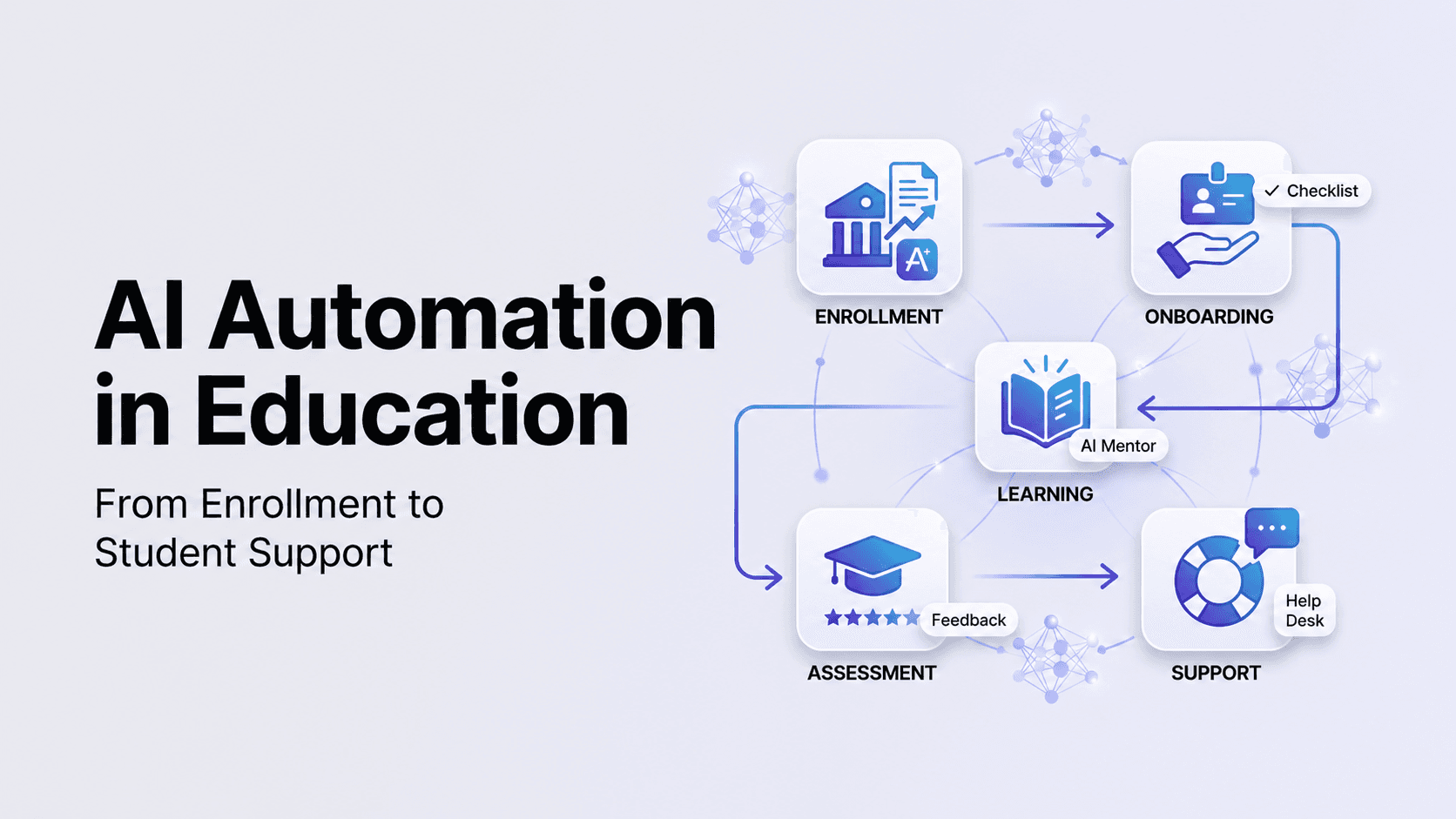
Education AI that frees educators to teach.
Education institutions face a growing paradox: student expectations for personalised support are rising while administrative burdens consume more staff time every year. Enrollment processing, student queries, scheduling, grading, compliance reporting, and financial aid administration absorb resources that should be directed toward teaching and learning outcomes.
AI automation handles the high-volume administrative tasks that scale with student numbers, letting educators and support staff focus on the interactions that genuinely require human judgement, empathy, and expertise.
60%
reduction in enrollment processing time reported by institutions using AI powered admissions workflows, with application-to-decision cycles dropping from weeks to days.
6 Workflows That Deliver Real Results
These workflows address the operational challenges that scale with student numbers. Each one reduces administrative burden while improving the student experience.
Enrollment and Admissions Processing
AI extracts data from applications, verifies documents, checks eligibility criteria, and generates preliminary assessments for admissions committee review. Automated status updates keep applicants informed throughout the process. Edge cases are flagged for human review with context.
60% faster processingStudent Support Chatbot
AI handles the 80% of student queries that are repetitive: timetable questions, deadline reminders, campus information, IT password resets, and financial aid status checks. Complex pastoral or academic concerns are routed to human advisors with full conversation context.
80% of queries resolved instantlyAutomated Grading and Feedback
AI grades objective assessments instantly and provides structured feedback on written assignments: grammar, structure, argument quality, and citation accuracy. Educators review and adjust AI generated feedback, focusing their time on substantive academic guidance.
Saves 8-12 hrs/week per educatorEarly Warning and Retention Systems
AI analyses attendance, grades, engagement metrics, and LMS activity to identify students at risk of dropping out. Automated alerts notify advisors with specific intervention recommendations. Proactive outreach happens before students disengage completely.
25% improvement in retention ratesScheduling and Resource Allocation
AI optimises class schedules, room assignments, and faculty workloads based on enrolment data, room capacity, equipment requirements, and faculty preferences. Re-optimises automatically when constraints change during the term.
30% improvement in room utilisationCompliance and Reporting Automation
AI collects data from student information systems, generates regulatory reports (accreditation, government funding, equality monitoring), and flags anomalies before submission. Eliminates the manual data assembly that consumes weeks every reporting cycle.
75% reduction in report prep timeData Privacy and Compliance
Education AI handles sensitive student data, including personal information, academic records, and welfare data. Compliance is not optional.
FERPA / GDPR Compliance
Student education records are protected data. AI systems must process data in compliance with FERPA (US) or GDPR (UK/EU), with clear data processing agreements, purpose limitation, and data minimisation built in.
Algorithmic Fairness
AI used in admissions, grading, or retention must be tested for bias across demographic groups. Regular audits ensure the system does not disadvantage students based on protected characteristics.
Transparency with Students
Students have the right to know when AI is being used in decisions that affect them. Clear disclosure policies build trust. Students should be able to request human review of any AI influenced decision.
Data Retention Policies
Student data should only be retained for as long as necessary. AI training data must be anonymised where possible. Clear retention and deletion schedules are required by most education regulators.
ROI Benchmarks
35-45%
Admin cost reduction
28%
Student satisfaction increase
20+ hrs/week
Staff time reallocated to teaching
Key finding: Institutions that deploy AI powered early warning systems see retention improvements of 15-25%. The cost of retaining an existing student is a fraction of recruiting a new one, making retention automation one of the highest-ROI investments in education.
Implementation Approach
Student Support Chatbot
Deploy an AI chatbot for common student queries: timetables, deadlines, campus info, IT support. Fastest time to value and lowest risk. Measure deflection rate and satisfaction scores.
Enrollment Processing
Automate application data extraction, document verification, and eligibility checks. Run in parallel with manual processes. Validate accuracy before full cutover.
Early Warning System
Connect LMS, attendance, and grade data to build at-risk student identification models. Start with a single cohort. Validate predictions against advisor assessments.
Grading Support and Reporting
Deploy automated grading for objective assessments. Add compliance reporting automation. These require more integration but build on the data foundation from earlier phases.
Key Takeaways
Education institutions spend disproportionate resources on administrative tasks that scale with student numbers. AI automation breaks that linear relationship.
The highest-ROI starting points are student support chatbots (instant value, low risk) and enrollment processing (high volume, clear rules).
Early warning systems that predict at-risk students deliver 15-25% retention improvements. Retention is cheaper than recruitment.
FERPA, GDPR, and algorithmic fairness requirements are non-negotiable. Build privacy and bias testing into every AI deployment from day one.
Start with one workflow, validate results, and expand. Institutions that try to automate everything at once typically fail to automate anything well.
Related service: AI Automation Services - end-to-end automation design, build, and deployment for education institutions.
Ready to Automate Your Education Operations?
We will identify your highest-impact automation opportunities and build compliant systems that free your team to focus on student outcomes.

From our work
Read how we did this for…
Accelerate your roadmap with AI-driven engineering.
Click below to get expert guidance on your product or automation needs.