AI Automation for Law Firms: From Document Review to Client Intake
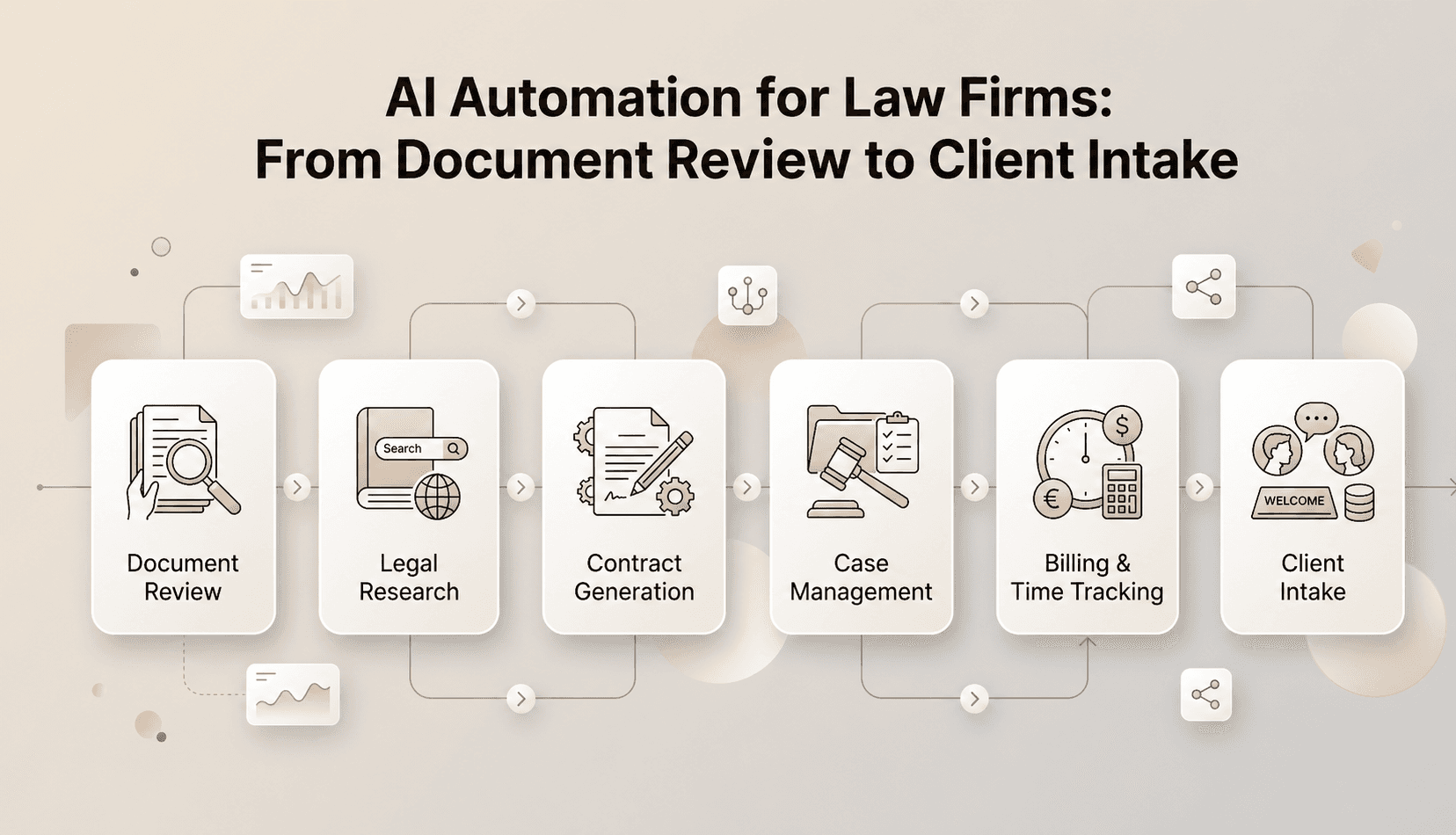
Legal AI automation that amplifies judgement, not replaces it.
Law firms operate on one of the most time-intensive business models in any industry. Associates spend 60% or more of their capacity on tasks that require attention but not necessarily legal judgement: document review, contract comparison, due diligence data extraction, intake form processing, and compliance checks.
AI automation handles the volume work so lawyers can focus on the high-value analysis, strategy, and client counsel that justify premium billing rates. The firms adopting it are not cutting lawyers. They are making each lawyer dramatically more productive.
70%
reduction in document review time reported by firms using AI-powered contract analysis tools, with accuracy rates matching or exceeding manual review.
6 High-Value Workflows to Automate
These workflows represent the greatest time savings with the lowest risk to client outcomes. Each keeps human judgement where it matters while automating the preparation and processing layers.
Contract Review and Clause Extraction
AI reads contracts, identifies key clauses (indemnity, termination, non-compete, liability caps), flags deviations from standard templates, and generates a clause-by-clause summary. Lawyers review the AI output instead of reading every page.
70% faster review cyclesClient Intake Automation
Automated intake forms collect client information, run conflict checks against existing matters, verify identity documents, and route new matters to the appropriate practice group. Reduces intake from days to hours.
Intake cycle: 3 days to 4 hoursDue Diligence Document Processing
AI extracts key data points from hundreds of documents in a data room: financial figures, material contracts, litigation history, IP filings. Generates structured summaries with source references for lawyer verification.
85% reduction in data room review timeLegal Research Acceleration
AI searches case law, statutes, and regulatory guidance based on natural language queries. Returns relevant precedents with jurisdiction-specific filtering and citation-verified results. Lawyers start from a curated shortlist instead of an open search.
5x faster research outputBilling and Time Entry Automation
AI captures time entries from emails, documents, and calendar events, classifies them by matter and billing code, and generates draft invoices for partner review. Eliminates end-of-month time reconstruction.
12% increase in captured billable hoursCompliance Monitoring and Alerts
Automated monitoring of regulatory changes relevant to client industries. AI flags new regulations, maps them to affected clients, and generates compliance briefing drafts for lawyer review and distribution.
Real-time regulatory coverageCompliance and Ethical Considerations
Legal AI automation operates under stricter ethical constraints than most industries. Professional conduct rules, client confidentiality, and the duty of competence all apply to how firms deploy AI.
Client Confidentiality
AI systems must process client data in secure, isolated environments. No client data should be used for model training. On-premise or private cloud deployments are often required for sensitive matters.
Duty of Competence
Lawyers remain responsible for AI-generated output. Every automated analysis requires lawyer review before it reaches clients. AI recommends; lawyers decide.
Transparency with Clients
Leading firms are proactively disclosing AI use to clients. This builds trust and sets appropriate expectations about speed, cost, and the role of technology in matter handling.
Audit Trails
Every AI-assisted decision must be logged with inputs, model version, output, and the reviewing lawyer. This is essential for professional indemnity insurance and regulatory compliance.
ROI Data from Early Adopters
40%
Average time saved per matter
2.3x
Increase in matters handled per lawyer
55%
Reduction in administrative overhead
Key insight: Firms that implement AI automation report higher associate satisfaction scores. When you remove the grunt work, lawyers spend more time on the intellectually challenging work that attracted them to the profession.
Implementation Approach
Legal AI automation requires a deliberate, phased approach. Start with low-risk workflows, validate accuracy, then expand.
Audit and Prioritise
Map all manual workflows by time cost and risk level. Identify the top 3 candidates. Get buy-in from practice group leaders and compliance.
Pilot on Client Intake
Automate intake forms, conflict checks, and matter routing. Run in parallel with manual processes. Measure accuracy and time savings.
Contract Review Automation
Deploy AI-assisted contract review for standard agreements. Lawyers review AI output. Track accuracy rate and iterate on clause extraction models.
Expand and Optimise
Roll out to additional practice areas. Establish monitoring dashboards, accuracy benchmarks, and quarterly review cycles with the compliance team.
Key Takeaways
Law firms spend 60%+ of capacity on tasks that require attention but not legal judgement. AI automation reclaims that time for higher-value work.
Contract review, client intake, and due diligence are the highest-ROI starting points. Each is high-volume, document-heavy, and well-suited to AI.
Client confidentiality and the duty of competence are non-negotiable. AI recommends; lawyers decide. Every output requires human review.
Firms using AI report 2.3x more matters handled per lawyer and 55% reduction in administrative overhead.
Start with a pilot on intake or standard contract review, validate accuracy, then expand to more complex workflows.
Related service: AI Automation Services end-to-end automation design, build, and deployment for legal teams.
Ready to Automate Your Legal Operations?
We will map your highest-value automation opportunities and build systems that respect client confidentiality and professional conduct rules.



From our work
Read how we did this for…


Accelerate your roadmap with AI-driven engineering.
Click below to get expert guidance on your product or automation needs.