The AI Literacy Imperative: Why Every Non-Technical Professional in Tech Must Get Fluent in 2026
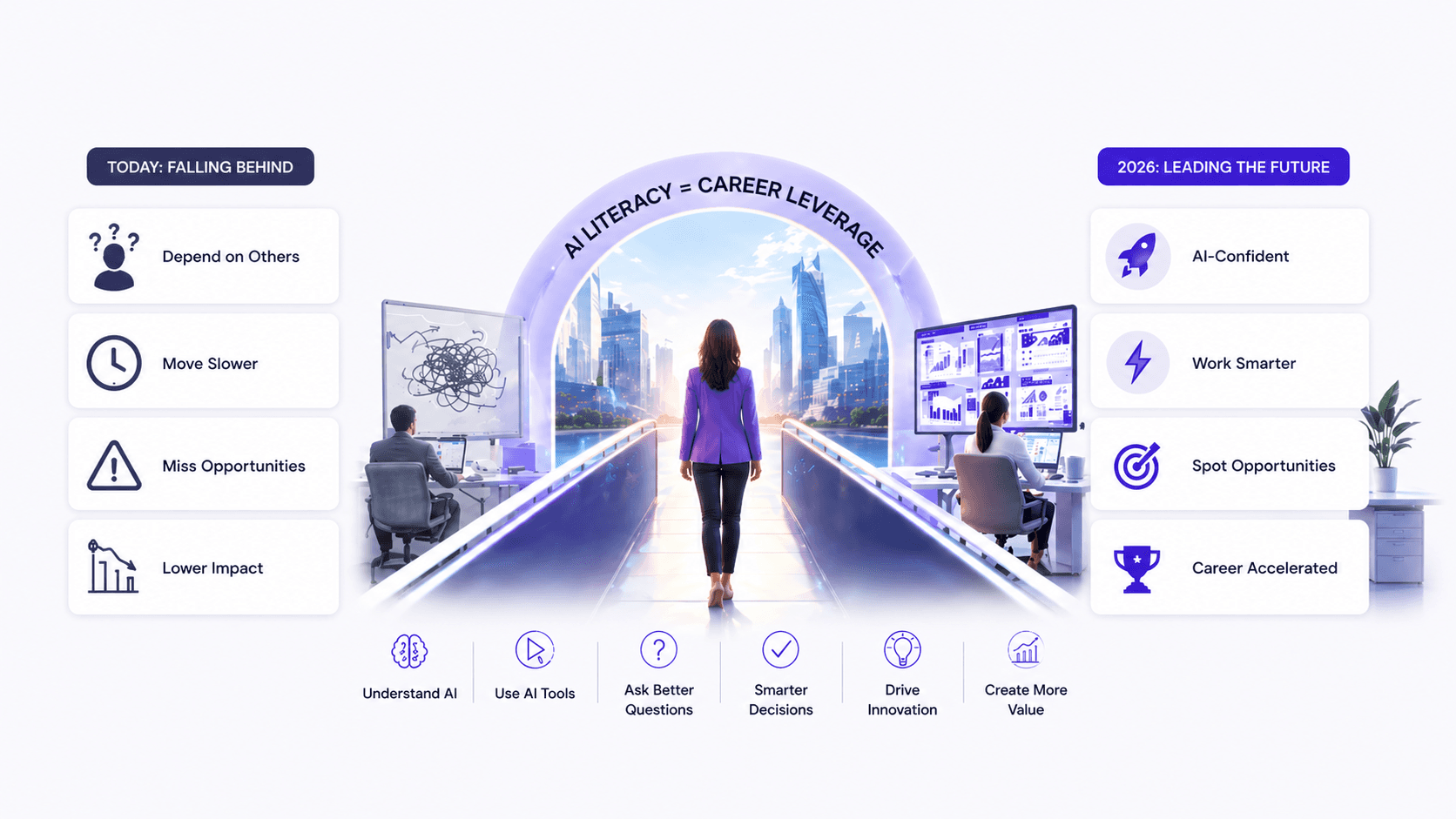
The AI Literacy Imperative: Why Every Non-Technical Professional in Tech Must Get Fluent in 2026 - Before AI Tools Get Fluent for Them
Published April 2026 | Estimated Read Time: 12 minutes
The Setup: A Quiet Revolution Is Happening on Your Floor
Picture your average Tuesday at a mid-size tech company. The engineers are shipping features. The product managers are running roadmap reviews. And somewhere in HR, marketing, or operations, a professional is spending an hour doing something AI could do in two minutes - because nobody ever showed them how.
That gap is no longer a training inconvenience. In 2026, it is a structural liability.
The conversation around AI literacy has fundamentally shifted. It is no longer about whether non-technical professionals should learn AI basics. Regulation, compensation data, and the collapse of the traditional SaaS model have already decided the answer. The only question left is how fast organizations will act before the cost of inaction becomes visible in headcount, salary benchmarks, and competitive positioning.
This blog explores why 2026 marks the definitive tipping point - backed by hard data, three detailed case studies from global organizations, and a clear look at the "build vs. buy" disruption rewriting enterprise software from the inside out.
SECTION 1: THE NUMBERS DON'T LIE - THE SKILLS GAP IS REAL AND EXPENSIVE
Stat Block 1: The AI Literacy Paradox
| Metric | Figure |
|---|---|
| Leaders who say AI/data literacy is essential | 88% |
| Enterprise leaders reporting an AI skills gap | 59% |
| Employees who use AI frequently today | 17% |
| Employees expecting their role to change significantly due to AI within 12 months | 42% |
| Employees who say their employer expects them to learn AI on their own | 42% |
| Workers who feel unprepared for AI-driven changes | 34% |
The paradox embedded in these numbers is striking. 88% of enterprise leaders say data and AI literacy is essential for day-to-day work, yet 59% report an AI skills gap - and only 42% provide foundational AI literacy training at scale. DataCamp Leaders expect the capability. They are not building it. And the people caught in the middle - HR professionals, marketing managers, operations leads, sales teams - are expected to bridge that gap on their own time.
42% of employees say their employer expects them to learn AI on their own, even as 34% report feeling unprepared for AI-driven changes. Only 17% use AI frequently today - a critical adoption gap given that nearly half expect their roles to change significantly within the year. Brighthorizons
Stat Block 2: The Compensation Premium for AI-Literate Non-Technical Professionals
| Role | AI Literacy Salary Premium |
|---|---|
| Non-technical professionals (general) | +43% |
| Workers with advanced AI skills vs. peers | +56% |
| Marketing & Sales AI-skilled professionals | +43% |
| Organizations with mature AI upskilling seeing strong ROI | 42% vs. 22% baseline |
PwC's analysis reveals that workers with advanced AI skills earn 56% more than peers in the same roles without those skills, while productivity growth has nearly quadrupled in industries most exposed to AI since 2022. Gloat
Non-technical professionals - marketers, HR practitioners, operations managers, and sales professionals - can use AI literacy to add a powerful differentiator to their existing domain expertise and earn up to 43% more as a result. Abhyashsuchi
The salary signal is unambiguous. AI fluency in non-technical roles is not a "nice to have" professional development path. It is a measurable pay differentiator that compounds with seniority.
Stat Block 3: Regulatory Signal - Governments Are Now Mandating It
In March 2026, the U.S. Department of Labor announced "Make America AI-Ready," a free AI literacy course intended to help American workers build foundational AI skills - a clear signal that literacy has moved from optional curiosity to a workforce policy issue. Zonetechai
The EU AI Act - the world's first comprehensive AI regulation - classifies workplace AI uses like recruitment and performance evaluation as "high risk," requiring transparency, human oversight, and worker notification. The EU AI Act now requires employers to ensure staff have sufficient AI literacy. Gloat
When legislation mandates your upskilling, the conversation is over. AI literacy for non-technical professionals is no longer a strategic differentiator. It is a compliance baseline.
SECTION 2: THE BIG DISRUPTION - WHY YOUR SAAS STACK IS BEING REPLACED BY INTERNAL AI TOOLS
This is the part most non-technical professionals in tech haven't connected yet: the software you use daily at work is being phased out - not by a competitor, not by a budget cut, but by AI tools your own organization is building internally. And if you don't understand how those tools work, you cannot use them, shape them, or protect yourself from their blind spots.
The "SaaSpocalypse" Is Not a Metaphor
The question of whether AI will disrupt the SaaS business model has been answered definitively in 2026 - it is already happening. Enterprise customers are building internal AI tools to replace purchased software, and a $285 billion market correction reflects investor recognition that traditional SaaS economics are under threat. Intellectia.AI
A new report from Retool found that 35% of respondents have already replaced the functionality of at least one SaaS tool with a custom internal build, and 78% expect to build more of their own tools in 2026. At the same time, 60% reported building something outside of IT oversight in the past year. Newsweek
That last figure is the most telling. Shadow IT is no longer a security team's nightmare about unauthorized Dropbox accounts. It is entire teams building internal AI-powered tools - outside governance, outside oversight, outside any literacy framework.
Build vs. Buy: The Equation That Changed
| Factor | Traditional SaaS | AI Internal Tools |
|---|---|---|
| Build cost | High (weeks, $100K+) | Low (days, minimal) |
| Customization | Generic, template-based | Tailored to exact workflow |
| Per-seat cost | Recurring, scales with headcount | Infrastructure-based |
| Governance | Vendor-managed | Organization-dependent |
| AI literacy required | Low (click-through UX) | Medium-High (prompt, review, validate) |
As Retool CEO David Hsu put it: "The cost of building custom software has collapsed. What used to take weeks of engineering time and six-figure budgets can now, in some cases, be prototyped in days. When the math changes that dramatically, behavior changes with it." Newsweek
A Databricks 2026 survey found multi-agent system usage spiked by 327% over just four months. Gartner predicts that 35% of point-product SaaS tools will be replaced by AI agents by 2030. Orbilon Technologies
For the HR manager whose ATS is being replaced by an internal AI recruiting agent, or the marketing analyst whose campaign reporting SaaS is being substituted by a Retool-built dashboard pulling from internal APIs - the question is no longer whether the tools are changing. It is whether they have the literacy to work with what replaces them.
SECTION 3: THREE CASE STUDIES FROM THE REAL WORLD
Bank of America - "Erica for Employees" and the 90% Adoption Benchmark
The Challenge: Bank of America, with over 213,000 employees spanning retail banking, wealth management, and global markets, faced a perennial internal friction: HR queries, IT support tickets, payroll questions, and benefits information were creating massive support desk backlogs and consuming employee time on tasks that added no client value.
What They Built: BofA launched Erica for Employees in 2020, initially focused on IT support but later expanded to HR, payroll, benefits, and enterprise knowledge search. Generative AI was subsequently integrated into multiple workflows, including coding assistants that increased developer efficiency by 20%, meeting preparation tools that saved tens of thousands of work hours, and call center optimization systems that improved personalization and reduced handling times. AI Expert Network
The Results:
- As of 2025, 90% of Bank of America's employees are actively using Erica for Employees, with IT service desk queries reduced by over 50%. Processexcellencenetwork
- Employees use the tool to access information related to benefits, payroll, time-off policies, compliance rules, and internal guidelines without navigating complex portals or waiting for human support. HR and policy queries, IT troubleshooting, and knowledge search are all handled conversationally. DigitalDefynd
The Literacy Insight: What made this work at scale was not the technology. It was the design decision to build for non-technical users from day one. Employees interact via natural language - no dashboards, no training manuals, no SQL. But employees still need to understand what the tool can and cannot do, how to frame queries effectively, and when to escalate to a human. That is AI literacy in a non-technical context. Without it, adoption would have stalled well below 90%.
Recommended Watch:
Goldman Sachs - GS AI Assistant and the Internal Knowledge Layer
The Challenge: Goldman Sachs operates at the intersection of high-stakes financial decisions and massive information density. Analysts spend hours summarizing regulatory documents, preparing client materials, and navigating internal policy databases. The bank had previously forbidden employees from using external ChatGPT for work due to data security concerns, creating a productivity vacuum that internal AI needed to fill. CNBC
What They Built: Goldman Sachs deployed the GS AI Assistant - a behind-the-firewall platform hosting multiple large language models including GPT-4, Gemini, Llama, and internal models - across its global workforce of 46,000+ employees. The platform includes specialized tools: "Banker Copilot" for data-heavy investment banking tasks, "Legend AI Query" for natural language internal data search, and "Translate AI" for converting research content into local languages. YourStory
The Results:
- Common administrative tasks such as summarizing a 20-page report or drafting meeting notes now take under 2 minutes, compared to 20–30 minutes previously. Helpdesk tickets beginning with "Where do I find…" or "How do I…" dropped by 18% as users relied increasingly on self-service answers. DigitalDefynd
- The platform achieved over 50% adoption among 46,000 employees, with productivity lifts on the order of 20% in key functions and a 15% reduction in post-release bugs on the engineering side. CEO David Solomon set a goal of 100% adoption among knowledge workers by 2026. Nanonets
The Literacy Insight: Goldman's rollout included AI "champions" in each business unit who ran workshops and promoted the tool as an augmentation - not a replacement - of human judgment. The framing mattered. Employees who understood what the model was drawing from (Goldman's proprietary data), what guardrails existed (encryption, role-based access, audit logs), and what tasks warranted AI assistance versus human deliberation were far more effective users. That is AI literacy at the enterprise level.
Recommended Watch:
Publicis Groupe + Microsoft - Marcel to Agentic AI at 114,000 Employees
The Challenge: Publicis Groupe, one of the world's largest marketing and communications networks with over 100,000 employees, needed to move its non-technical workforce - creatives, strategists, media planners, account managers - from passive AI awareness to active AI workflow integration. Traditional SaaS tools for campaign management, content creation, and media optimization were fragmenting their technology stack and creating inefficiency.
What They Did: Publicis and Microsoft expanded their decade-old partnership to build a full-stack marketing solution that unifies legacy systems, AI agents, and identity-based data. The partnership integrates Microsoft Copilot Studio, Agent 365, and Microsoft IQ into Publicis Sapient's Bodhi agentic AI platform, enabling employees to embed AI directly into core business processes including marketing, commerce, and customer engagement. Microsoft News
The Results:
- More than 114,000 Publicis employees worldwide gained access to Microsoft 365 Copilot to boost internal productivity, with Publicis naming Azure its preferred cloud provider. The goal is to give creatives and makers "the freedom to spend less time on repetitive execution and more time shaping ideas." eMarketer
- In parallel, Publicis Sapient built an AI tool for non-technical users at The AA (UK) that enabled plain-language data queries, removing the need for complex dashboards or coding expertise. The solution aimed to reduce routine data requests by 50% weekly while maintaining high response accuracy. Computing
The Literacy Insight: Publicis' strategy reveals something critical: deploying AI tools at scale across non-technical workers only produces ROI when those workers know how to interrogate the outputs.
A creative director using Copilot to generate campaign briefs still needs to know what good judgment looks like when reviewing AI drafts - to catch brand inconsistency, regulatory violations, or strategic misfires. Tools do the work. Literacy determines whether the work is any good.
Recommended Watch:
SECTION 4: WHAT "AI LITERACY" ACTUALLY MEANS FOR NON-TECHNICAL PROFESSIONALS
This is where most organizations get it wrong. AI literacy for a marketer, an HR business partner, a finance analyst, or an operations manager is not about learning Python. It is about five practical competencies:
The 5 Competencies Framework
1. Prompt Engineering for Your Role
Knowing how to structure inputs to get useful outputs from AI tools - with role context, constraints, and desired formats. Prompt engineering, AI-augmented workflows, and the judgment to evaluate AI output critically are the relevant skills. In non-technical roles, AI literacy alone is now driving measurable salary differentiation in the market. KnowledgeCity
2. Output Evaluation (Not Blind Trust)
Understanding when AI outputs are reliable, when they need verification, and when the task should not be delegated to AI at all. The bigger gains often come from better task selection, better review habits, and better expectations - not from cleverer prompting. Sometimes the right move is narrowing the assignment, providing verified context, or deciding that a task should not be outsourced to AI at all. Zonetechai
3. Data Awareness Without Being a Data Scientist
Knowing what data the AI tool is drawing from, what it cannot access, and what the implications of that boundary are for the output you receive. Enterprise-wide competitiveness depends on foundational data and AI literacy at scale. DataCamp
4. AI Ethics and Responsible Use
Understanding which tools are approved in your organization, what data is off-limits, and what governance protocols apply. Workers must understand the boundaries of appropriate use - both to safeguard information and to ensure outputs are applied ethically and effectively. This includes recognizing the limits of AI authority, protecting sensitive data, complying with workplace or legal requirements, and maintaining accountability for outcomes. U.S. Department of Labor
5. Workflow Integration
Being able to identify which of your recurring tasks can be augmented by AI, design the workflow change, and measure the before/after impact - without waiting for IT to build it for you.
Role-Specific Priorities
| Role | Priority AI Skill | Why It Matters Now |
|---|---|---|
| HR Business Partner | AI-assisted candidate screening, policy Q&A bots | Internal AI tools replacing ATS SaaS |
| Marketing Manager | Generative content review, campaign brief prompting | AI agents now running campaigns end-to-end |
| Operations Analyst | Workflow automation, plain-language data queries | 35% of SaaS tools already replaced by internal builds |
| Finance Analyst | AI-assisted financial modeling review, anomaly flagging | AI embedded in ERP and BI tools |
| Legal / Compliance | AI output audit, regulatory AI governance | EU AI Act mandates literacy at the compliance level |
SECTION 5: THE ORGANIZATIONAL ROI OF GETTING THIS RIGHT
What Organizations Gain When They Invest in AI Literacy at Scale
Organizations pairing AI investment with structured workforce capability building are nearly twice as likely to see strong returns - the share reporting significant AI ROI jumps from 22% to 42% with a mature upskilling program. DataCamp
The World Economic Forum reports that 77% of employers plan to reskill workers for AI between 2025 and 2030. Yet only 13% of workers have received AI training in past years - showing a large structural gap. Meanwhile, 46% of leaders believe skill gaps slow down AI adoption, affecting company progress. Second Talent
The Bank of America case is the clearest proof of scale: a 90% adoption rate across 213,000 employees, 50% reduction in IT support volumes, and measurable productivity gains in developer efficiency - all flowing from a deliberate strategy to build AI tools for non-technical users and then train those users to use them well.
Goldman Sachs demonstrates the ceiling of what's possible when the right framing accompanies deployment: 20% productivity lifts, 18% reduction in routine helpdesk queries, and administrative tasks that once took half an hour completed in under two minutes.
What Organizations Lose When They Don't
Shadow IT. 60% of enterprise respondents have built software outside IT oversight in the past year, and 25% report doing so frequently. 75% of builders now work under AI directive, but 35% of organizations still haven't established AI productivity metrics. Business Wire
Ungoverned AI proliferation creates security exposure, compliance risk, and operational fragmentation. When non-technical employees lack AI literacy, they either don't use the tools at all (leaving productivity on the table) or use them without guardrails (creating liability). Neither outcome is acceptable in 2026.
SECTION 6: A PRACTICAL STARTING POINT FOR NON-TECHNICAL PROFESSIONALS
You do not need to become an AI engineer. You need to become an informed collaborator. Here is a concrete 90-day path:
Month 1 - Foundation
DAYS 1-30- ✓Complete one structured AI literacy course path
- ✓Identify three recurring tasks in your role for experimentation
- ✓Learn your organization's approved AI tools and governance
Month 2 - Application
DAYS 31-60- ✓Build a personal prompt library for recurring tasks
- ✓Practice output evaluation for every AI draft
- ✓Attend or run a team workshop on an AI tool
Month 3 - Integration
DAYS 61-90- ✓Redesign one workflow with AI assistance
- ✓Document change and share results for career value
- ✓Advocate for formal AI literacy in your team/unit
CLOSING: THE WINDOW IS NARROW
The professionals who will thrive in the next three years are not the ones who learned to code. They are the ones who learned to think clearly about what AI can and cannot do - and then worked alongside it deliberately, with judgment, in roles that required domain expertise the tools don't have.
By the end of 2026, AI literacy is destined to become an essential skill. Whether you're in HR, marketing, finance, IT, or operations, you will most likely need to understand how to apply AI in your environment - similar to how Microsoft Office became the minimum standard in the early 1990s. The Connors Group
The tools are already in your building. Your internal SaaS stack is being quietly replaced. The salary premium for AI-literate non-technical professionals is already priced in. Regulation has stepped in to make it mandatory in regulated industries. Every signal points the same direction.
The only variable left is whether you get ahead of it - or wait until someone else does.
KEY STATS AT A GLANCE
Sources and Further Reading
DataCamp: Inside the 2026 State of Data & AI Literacy Report
datacamp.com
Bright Horizons: EdAssist Education Index 2025 Media Kit
brighthorizons.com
Retool: 2026 AI Build vs. Buy Report and Analysis
retool.com
Bank of America: AI Adoption Improves Global Workforce Productivity
newsroom.bankofamerica.com
Reuters: Goldman Sachs Launches Firmwide AI Assistant
reuters.com
Microsoft: Expanding Partnership with Publicis Groupe for Agentic Marketing
news.microsoft.com
Deltek: Federal AI Landscape 2026-2028 (GovWin Analysis)
info.deltek.com
IBM: AI Agents and Autonomous Workforce Solutions
ibm.com
Publicis Sapient: Agentic Marketing Platforms and Digital Transformation
publicissapient.com
All market projection and workforce data is based on industry reports as of April 2026.
From our work
Read how we did this for…
Accelerate your roadmap with AI-driven engineering.
Click below to get expert guidance on your product or automation needs.