From SaaS Chaos to Composable Control: Rethinking Internal Platforms.
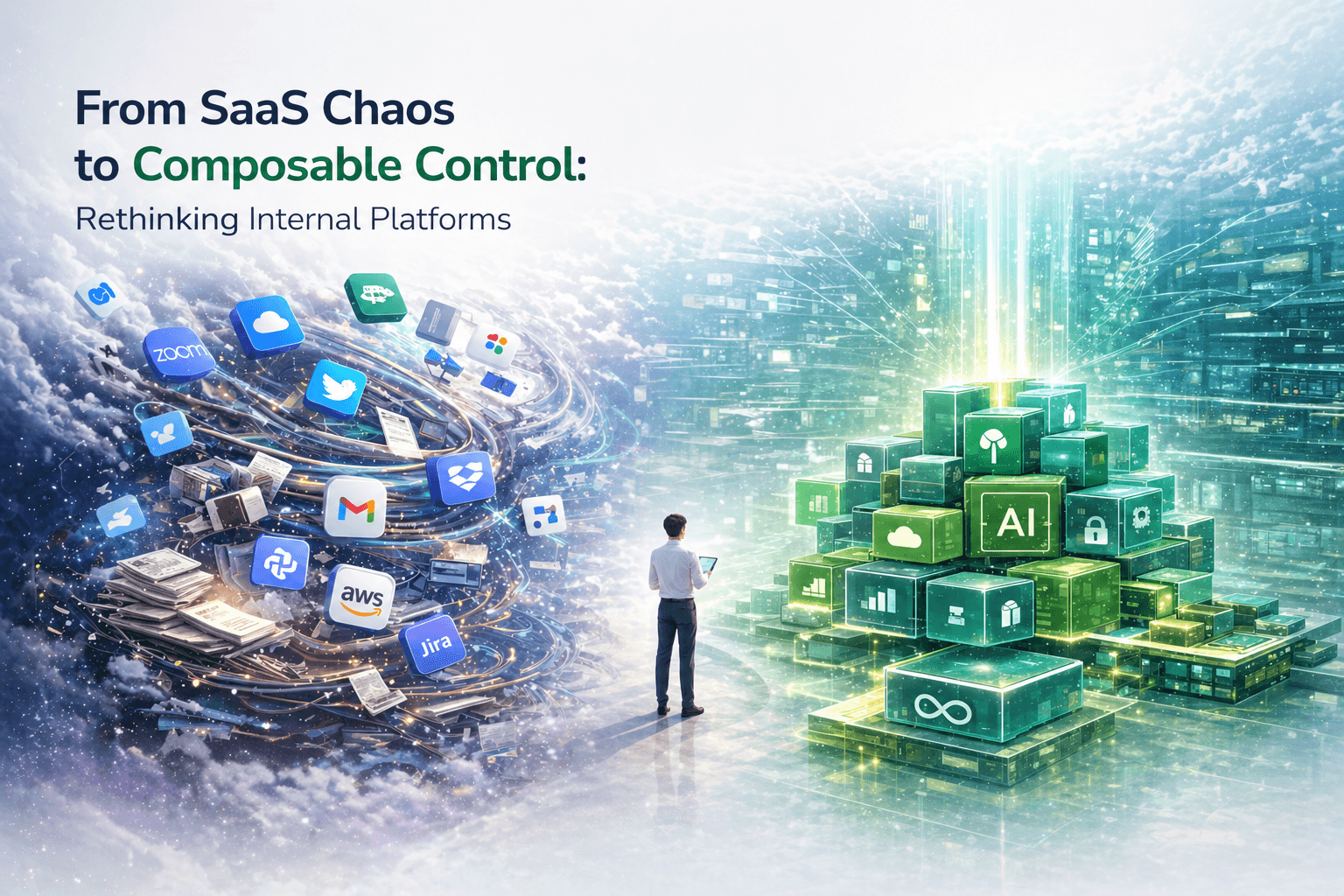
SaaS traps teams in someone else's roadmap. Custom monoliths trap them in yesterday's requirements. Smart organizations increasingly avoid both traps by building composable platforms: modular internal software systems that can evolve with business changes, AI integration, and team growth without requiring full rewrites every time priorities shift.
Custom software often solves the current problem well but ages poorly when the business changes faster than the architecture.
The goal is to identify the highest-friction business processes and turn them into reusable, extensible platform capabilities.
The Monolith Trap
What begins as a helpful internal application can become a backlog magnet when every new requirement must pass through one codebase, one team, and one release cycle.
Common failure patterns include:
- Feature bloat: From repeated quick additions that muddy the original architecture.
- Duplicate tooling: Built by different teams because existing systems were too rigid to adapt.
- Integration debt: Caused by unmanaged connectors that break when source systems update.
- Data silos: Models that are difficult to reuse for modern AI workflows or cross-team reporting.
What Makes a Platform Composable
Composable platforms are not just modular in code structure. They are modular at the business capability level.
API-First Design
Every capability is exposed through stable, well-documented interfaces.
Domain-Owned Data
Teams publish usable data products rather than siloed internal reports.
Workflow Abstraction
Approvals, notifications, and routing logic can be configured instead of rewritten.
Self-Service Access
Operations teams can assemble what they need without waiting on a central engineering queue.
Why AI Raises the Stakes
AI agents and workflow copilots work best when they can call well-scoped capabilities instead of navigating tangled monoliths. A composable platform gives AI systems cleaner APIs, clearer data boundaries, and safer execution patterns.
Instead of asking an agent to operate a giant internal app, teams can let it query a customer profile service, trigger a risk check, update an activity feed, or initiate an approval workflow as separate controlled actions.
That makes automation safer, more observable, and far easier to improve over time.
Platform Maturity Model
Most teams move through a predictable progression as they scale their internal operations.
SaaS sprawl
Point-to-point integrations and poor visibility across disconnected tools.
Custom monolith
Strong fit at first, but growing delivery friction as requirements evolve.
Composable platform
APIs, reusable workflows, and domain-owned data become the standard.
AI-native platform
Agents help orchestrate capabilities inside clear, governed guardrails.
The real step change happens between levels two and three.
How Tectome Helps
Tectome helps businesses move from fragmented tools and brittle internal systems to composable platforms that support growth. This usually starts with capability mapping followed by architecture design for APIs, workflow orchestration, data access, and automation guardrails.
Reduced Pain
Eliminating operational friction caused by disconnected systems and manual handoffs.
Improved Efficiency
Leveraging reusable automation and self-service workflows to speed up delivery.
Scalable Growth
Building platform foundations that do not need constant rework as you scale.
Better Conversions
Connecting internal operations more tightly to sales and service delivery systems.
Where This Approach Works Best
Composable internal platforms are especially useful when several of these conditions are true:
- More than one team depends on the same workflows or operational data.
- Business rules change often and need to be updated quickly across systems.
- Several SaaS systems already exist, but the real problem is coordinating them.
- AI agents, copilots, or advanced automation will need structured system access.
- The organization wants long-term flexibility without rebuilding from scratch every year.
Recommended Viewing
Composable AI-Native Applications
Building IDPs with Kratix
Zero to Fully Operational Platform
What is an IDP?
AI Agent Architectures
AI Agents Architecture Essentials
Composable Data Platforms
Key Takeaways
Composable internal platforms sit between off-the-shelf SaaS and rigid custom monoliths. They give organizations a way to own the workflows, data access patterns, and automation logic that matter most while remaining flexible enough to adapt.
That is what makes them a strong next-step topic after build-versus-buy conversations.
Ready to Build a Composable Platform?
Move beyond the build vs buy trap. Let's design a platform that evolves with your business.
Related reads
From our work
Read how we did this for…

Accelerate your roadmap with AI-driven engineering.
Click below to get expert guidance on your product or automation needs.