How Much Does an AI Agent Cost? Real Pricing for 2026
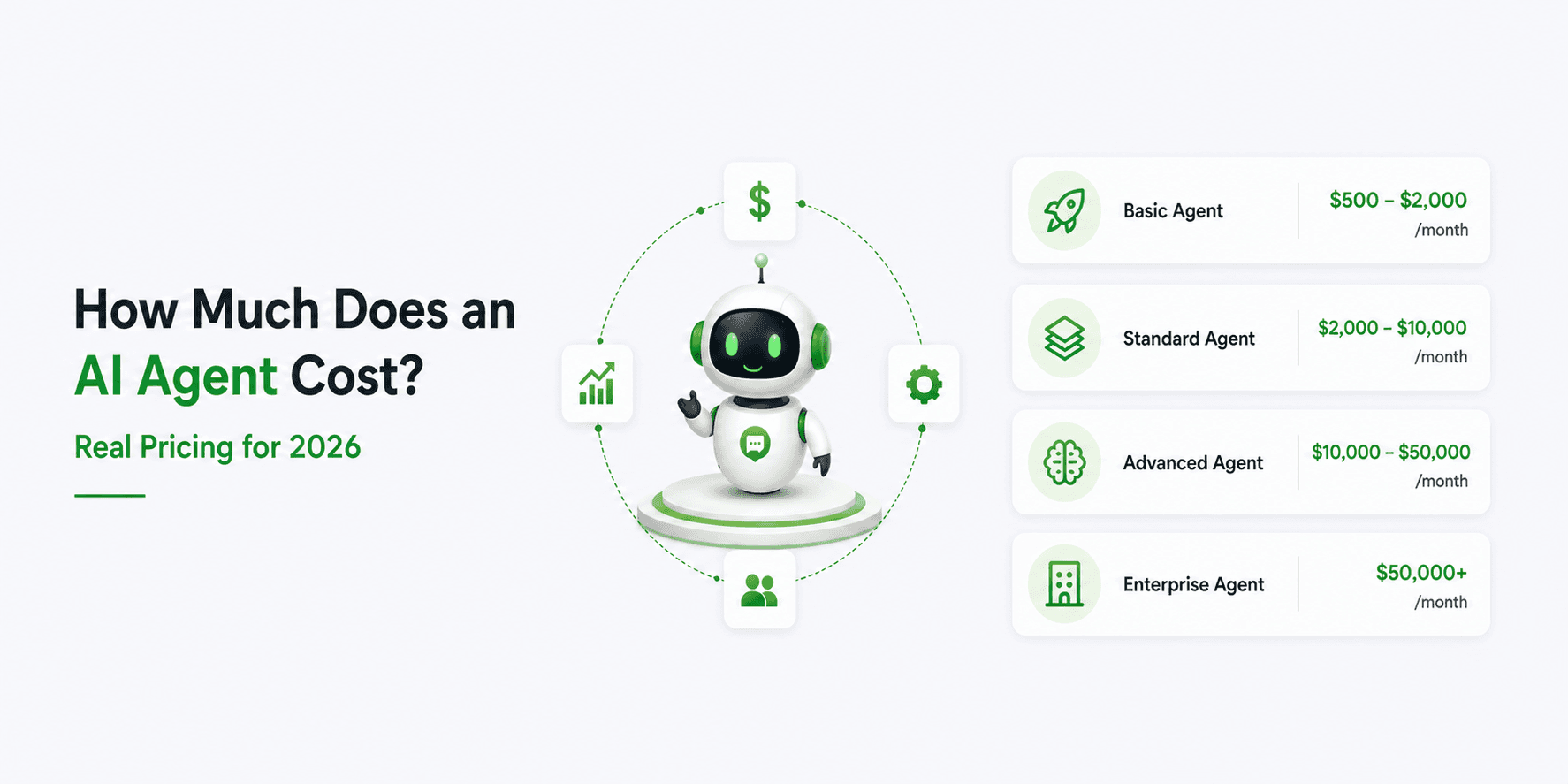
$5K to $500K.
Here's what you'll actually pay.
2026 US Market Pricing
Starter AI agent
Single-purpose agent, one integration, basic LLM prompting, no custom UI
Growth-stage multi-agent system
2–3 agents, CRM integration, custom dashboard, human-in-the-loop
Enterprise AI platform
Multi-agent orchestration, custom models, full workflow automation, compliance
US businesses shopping for AI agents are getting quotes that vary by 100x. A lead qualification bot from one vendor is $3,000. The same scope from another is $75,000. The difference isn't quality it's positioning, overhead, and how much discovery the vendor did before quoting.
This guide cuts through the noise. We break down what AI agents actually cost in 2026, what drives the price up or down, what ROI you can realistically expect, and how long each tier takes to deliver. All numbers are in USD.
Three Pricing Tiers
Almost every AI agent project falls into one of three tiers. Knowing where yours sits gives you an immediate ballpark and helps you spot vendors who are overcharging for what should be a simpler build.
$2K–$5K
Project cost
+ $1K–$2K/mo ongoing
- Single AI agent, single purpose
- One system integration (CRM, email, or helpdesk)
- Basic LLM prompting with standard APIs
- No custom user interface
- Examples: lead qualification bot, inbox triage agent, FAQ responder
$5K–$15K
Project cost
+ $1K–$2K/mo ongoing
- 2–3 coordinated AI agents
- CRM + 2–4 system integrations
- Custom dashboard or operator UI
- Human-in-the-loop review steps
- Examples: sales research pipeline, support escalation router, onboarding automation
$15K–$35K+
Project cost
+ $3K–$5K/mo ongoing
- Multi-agent orchestration with custom models
- Full workflow automation across departments
- SOC 2 / HIPAA compliance built in
- Role-based access, audit logging, observability
- Examples: underwriting pipeline, regulatory reporting, multi-department ops platform
The monthly costs cover LLM API usage (OpenAI, Anthropic, etc.), cloud hosting, and basic maintenance. They scale with transaction volume a starter agent processing 200 leads/month sits at the low end; an enterprise system handling thousands of daily LLM calls pushes toward the upper range.
What Drives the Cost Up
These are the factors that push AI agent projects toward the higher end of each tier or into the next tier entirely.
Custom Model Fine-Tuning
Off-the-shelf LLMs handle 80% of use cases. But if your domain has specialized terminology, proprietary data formats, or requires reasoning patterns that general models struggle with, fine-tuning a custom model adds significant cost. This includes data preparation, training compute, evaluation, and ongoing model maintenance.
Compliance Requirements (SOC 2, HIPAA)
SOC 2 Type II compliance means audit logging, encryption at rest and in transit, access controls, penetration testing, and documentation that satisfies your auditor. HIPAA adds BAA requirements, PHI handling protocols, and breach notification workflows. These aren't optional line items — they're structural requirements that affect every architectural decision.
Multi-System Integration Complexity
Each system your agent connects to — Salesforce, HubSpot, Zendesk, Slack, internal databases, ERPs — adds engineering time for authentication, data mapping, error handling, rate limiting, and testing. Legacy systems without modern APIs can double or triple this cost per integration.
Custom UI / Dashboard
If your team needs a custom interface to monitor the agent, review its decisions, or override its actions, that's a separate frontend build. Simple status dashboards sit at the low end. Full operator consoles with real-time metrics, approval workflows, and role-based views push toward the top.
What Drives the Cost Down
Smart scoping decisions can cut your project cost by 30–50% without sacrificing outcomes. Here's what keeps the bill low.
Using Existing LLM APIs
GPT-4o, Claude, Gemini — these models are remarkably capable out of the box. If your use case works with prompt engineering and retrieval-augmented generation (RAG) instead of custom fine-tuning, you save $5K–$20K in model development costs.
Standard CRM Integrations
Salesforce, HubSpot, and Pipedrive have mature APIs with well-documented authentication flows. Integrating with a standard CRM costs $1K–$2K vs $4K–$8K for a legacy system with a proprietary API.
Clear, Written Scope
Coming to your vendor with documented workflows, defined success criteria, and a list of systems to integrate eliminates discovery ambiguity. Vendors pad quotes by 20–40% when scope is fuzzy. A clear brief gets you a tighter number.
Phased Delivery
Building one agent first, proving ROI, then expanding to a multi-agent system reduces upfront risk and cost. A $15K project becomes a $5K Phase 1 and a $10K Phase 2 — with the option to stop if Phase 1 doesn't deliver.
ROI: What You Actually Save
The math on AI agents is straightforward. Labor is the biggest operating cost for most SMBs, and AI agents directly offset it. Here's what we see across our client base.
Typical US SMB Savings
Annual labor cost savings
Replacing or augmenting 1–3 full-time roles in sales ops, support, or back-office
Payback period
Most starter and growth-tier projects pay for themselves within one quarter
Throughput increase
Agents process leads, tickets, or documents 24/7 without breaks or context-switching
Consider a concrete example: a US B2B company spending $120,000/year on two SDRs for lead qualification. A $5K starter agent handles inbound lead scoring and routing, runs 24/7, and frees one SDR to focus on high-value outbound. Net savings after agent costs: $50K–$80K in year one. By year two, the ROI compounds as the agent improves and volume scales.
The question isn't whether AI agents save money for US businesses. It's whether you're leaving $80K–$200K on the table by not deploying one yet.
Realistic Timelines
Vendors who promise a production AI agent in “a few days” are either selling you a template or haven't done this before. Here's what each tier actually takes from kickoff to production.
| Phase | Starter | Growth | Enterprise |
|---|---|---|---|
| Discovery & scoping | 2–3 days | 1 week | 1–2 weeks |
| Architecture & design | 1–2 days | 1 week | 2–3 weeks |
| Development | 1–2 weeks | 2–4 weeks | 4–8 weeks |
| Testing & QA | 2–3 days | 1–2 weeks | 2–3 weeks |
| Deployment & monitoring | 1–2 days | 3–5 days | 1–2 weeks |
| Total Timeline | 2–4 weeks | 4–8 weeks | 8–12 weeks |
These timelines assume a vendor who has built AI agents before and a client who provides access to systems and stakeholders on schedule. The two biggest timeline risks we see are delayed API access (waiting 3 weeks for Salesforce admin credentials) and scope creep (“can it also do X?” mid-build). Both are preventable with proper discovery.
US-Specific Considerations
Building AI agents for US businesses involves regulatory and vendor landscape factors that affect both cost and architecture decisions.
SOC 2 Compliance Is Table Stakes
Most US enterprise buyers require SOC 2 Type II compliance from any vendor handling their data. If your AI agent processes customer information, expect your vendor to either already be SOC 2 certified (saving you time) or to build compliance into the project scope (adding $3K–$15K). This is non-negotiable for selling into mid-market and enterprise.
HIPAA for Healthcare Use Cases
Healthcare organizations deploying AI agents for patient intake, scheduling, or clinical documentation need HIPAA-compliant infrastructure. This means BAA agreements with every sub-processor, encrypted data handling, access audit trails, and breach notification protocols. Budget an additional $5K–$15K for HIPAA-ready architecture.
US Vendor Landscape
The US market has the deepest bench of AI agent vendors — from offshore shops quoting $2K to Big Four consultancies quoting $500K for the same scope. The sweet spot for most SMBs is a specialized AI agency (like Tectome) that has built production agents before, works in fixed-price scoped projects, and can reference similar deployments.
State-Level Data Privacy Laws
California (CCPA/CPRA), Virginia (VCDPA), Colorado, Connecticut, and other states have their own data privacy requirements. If your AI agent processes consumer data across multiple states, your vendor needs to account for the most restrictive applicable framework. This adds complexity to data handling and consent workflows.
Next Steps
If you're a US business evaluating AI agents, the worst thing you can do is collect five vague quotes and pick the cheapest one. The best thing you can do is get a structured audit of your workflows before you spend a dollar on development.
A starter AI agent costs $2K–$5K to build and $1K–$2K/month to run. It handles a single workflow (lead qual, inbox triage, FAQ) and deploys in 2–4 weeks.
A growth-tier system costs $5K–$15K with 2–3 agents, CRM integration, and a custom dashboard. Expect 4–8 weeks to production.
Enterprise deployments ($15K–$35K+) involve multi-agent orchestration, custom models, SOC 2 or HIPAA compliance, and 8–12 weeks of delivery time.
The typical US SMB saves $80K–$200K/year in labor costs. Most projects pay for themselves within one quarter.
The biggest cost drivers are custom model training, compliance requirements, and multi-system integrations. The biggest cost reducers are clear scope, standard APIs, and phased delivery.
Get a Free Automation Audit
We'll map your workflows, identify the highest-ROI automation opportunities, and give you a fixed-price quote no obligation, no vague ranges.
Get a Free Automation AuditRelated services
Related Reading



From our work
Read how we did this for…


Accelerate your roadmap with AI-driven engineering.
Click below to get expert guidance on your product or automation needs.